
Cover Story
A historic return to Foster Hall:
Built then. Revived now.
BY DANIELLE LEGARE
After a $41 million transformation, the historic building reopens on South Campus—where memory meets momentum.

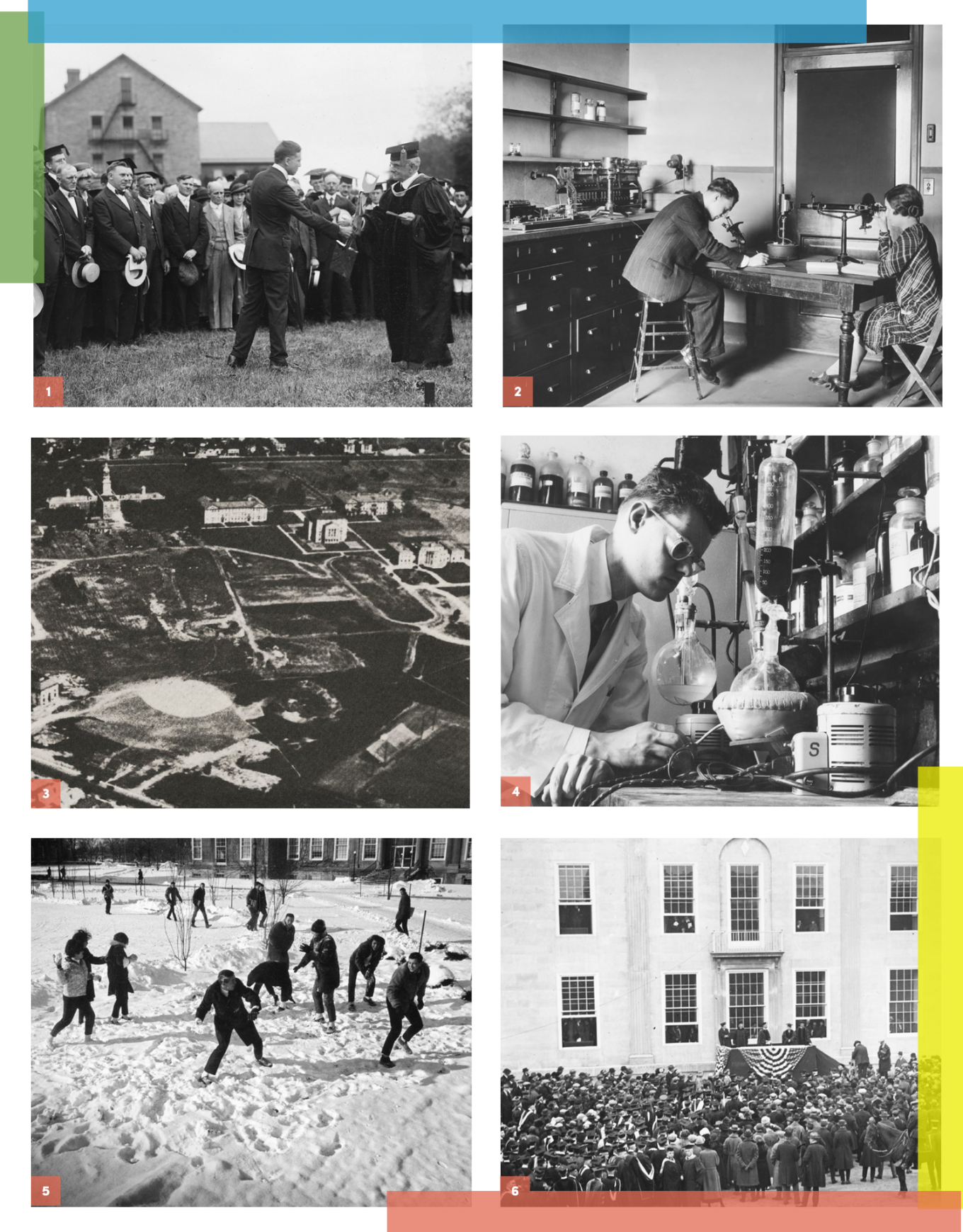
1. UB Chancellor Charles P. Norton broke ground for Foster Hall on June 11, 1920. Courtesy, University Archives.
2. Two students studied in a Foster Hall lab in the 1920s. Courtesy, University Archives.
3. Aerial view of South Campus, circa 1934-37. Courtesy, University Archives.
4. A student worked in a Foster Hall lab in 1950. Courtesy, University Archives.
5. Students had a snowball fight in front of Foster in the 1960s. Courtesy, University Archives.
6. A crowd gathered for the inauguration of Samuel P. Capen and Foster Hall’s dedication in October 1922. Courtesy, University Archives.
Maria Runfola still remembers the moment she yawned in Foster Hall.
Now a professor emeritus in the Department of Learning and Instruction, Runfola first encountered the building as an undergraduate while completing her certification requirements at UB in the early 1970s. She sat among hundreds of students in a large, tiered lecture hall heated by steam radiators that often left the room uncomfortably warm. One afternoon, midway through Professor Richard Poole’s course on measurement and evaluation, he singled her out in front of the class for appearing disengaged.
“It was embarrassing,” she said. “All I really needed was some fresh air.”
Decades later, the memory stayed with her, in part because Poole’s course would go on to shape her career in music education, where measurement and evaluation became central to her work.
A return to familiar ground
Runfola was one of many UB students who passed through Foster Hall when education programs were based on the South Campus. Long before GSE relocated to Baldy Hall on the North Campus in 1973, Foster served as an academic home for what would become GSE.
Today, the school’s move back into the building marks a return to an earlier chapter in its history.
Completed in 1921, Foster Hall was the university’s first academic building on the South Campus along Main Street. Designed by McKim, Mead & White and funded by a $500,000 gift from philanthropist Orrin Elliott Foster, the building first housed the Department of Chemistry before later becoming home to education programs.
After GSE moved, the building continued to support UB’s academic mission, most recently serving the School of Dental Medicine.
“Foster Hall was where GSE first took shape—where future teachers, leaders and scholars began their journeys nearly a century ago,” said GSE Dean and Professor Suzanne Rosenblith.
A familiar face, restored for a different moment
Now, after a three-year, $41 million renovation, Foster Hall still looks like Foster.
Set along Main Street in the City of Buffalo, the building remains a jewel on UB’s South Campus. The lines are the same. The presence is the same. And the building’s outward character remains intact, with one notable difference.
The Main Street entrance has been reopened as a true front door. During renovations in the early 1980s, that entrance had been closed off and repurposed as a loading dock—a practical decision at the time, which ultimately turned the building inward. In addition to recent exterior refinements, Foster’s interior has been reshaped to support the rhythms of a contemporary academic community.
“We wanted it to be a welcoming space and to maximize natural light,” said Kelly Hayes McAlonie, architect and director of campus planning, who collaborated with Mitchell Giurgola, the project’s architectural consultant.
“Foster Hall was where GSE first took shape—where future teachers, leaders and scholars began their journeys nearly a century ago.”
—Suzanne Rosenblith, GSE Dean and Professor
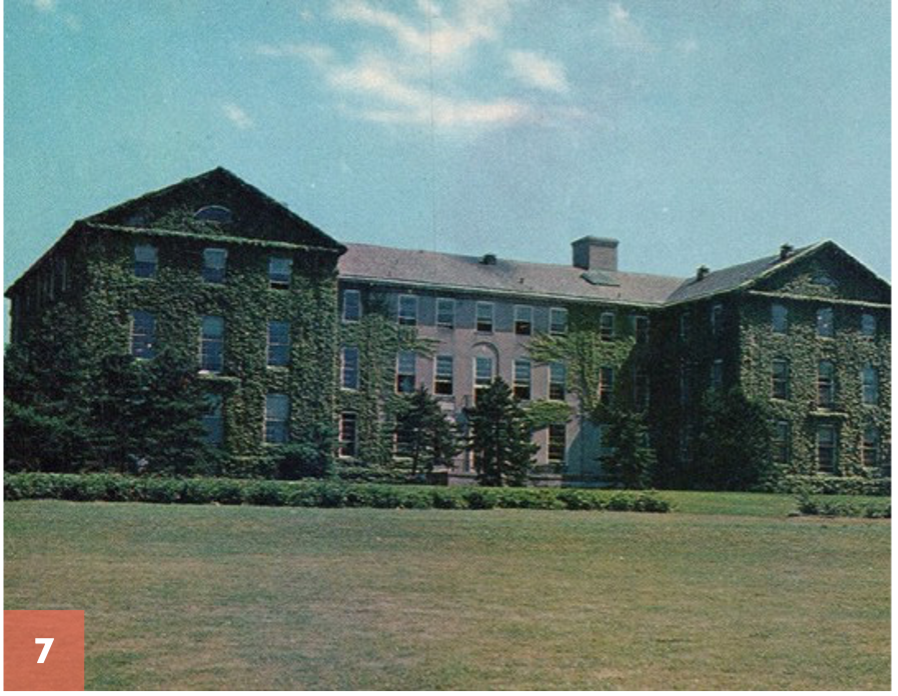
7. Vintage postcard of Foster Hall, circa 1950.

8. Construction underway at Foster Hall in June 2023.

9. Foster Hall in July 2024, as construction continued.

10. Foster Hall in late October 2025.

11. Foster Hall in July 2024, as construction continued.

12. Interior construction in January 2023.

13. Continued construction progress in March 2025.

14. Between classes, students sit in the light-filled lounge on the first floor of Foster Hall in January 2026.
What Foster makes possible
For decades, Baldy Hall on UB’s North Campus was where GSE did its thinking and grew into the school it is today. There, the GSE community expanded its research portfolio and strengthened its partnerships with schools and communities.
Over time, however, GSE’s work became more collaborative, community-facing and interdisciplinary. The limits of the space became harder to ignore.
The school, its work and its people had changed. And its home needed to acknowledge that. Faculty and staff began moving into Foster Hall in October 2025, with students and classes following in the spring semester.
From the moment the GSE community arrived, it was clear that the building shaped how learning and connection happen throughout the day. Students, faculty, staff and community partners gather informally before class, pause midconversation on the staircase and spread out across lounges between meetings and study sessions.
“There’s definitely a little more of a buzz,” Rosenblith said. “Toward the end of the day, you see students milling about. It’s really fun to see the building full of activity.”
“This building reflects GSE’s pedagogy, which is small-group learning,” said Hayes McAlonie. “We wanted to have a welcoming front entry, flanked by what we call learning landscapes, which are lounges, because we want students to feel that this is their home.”

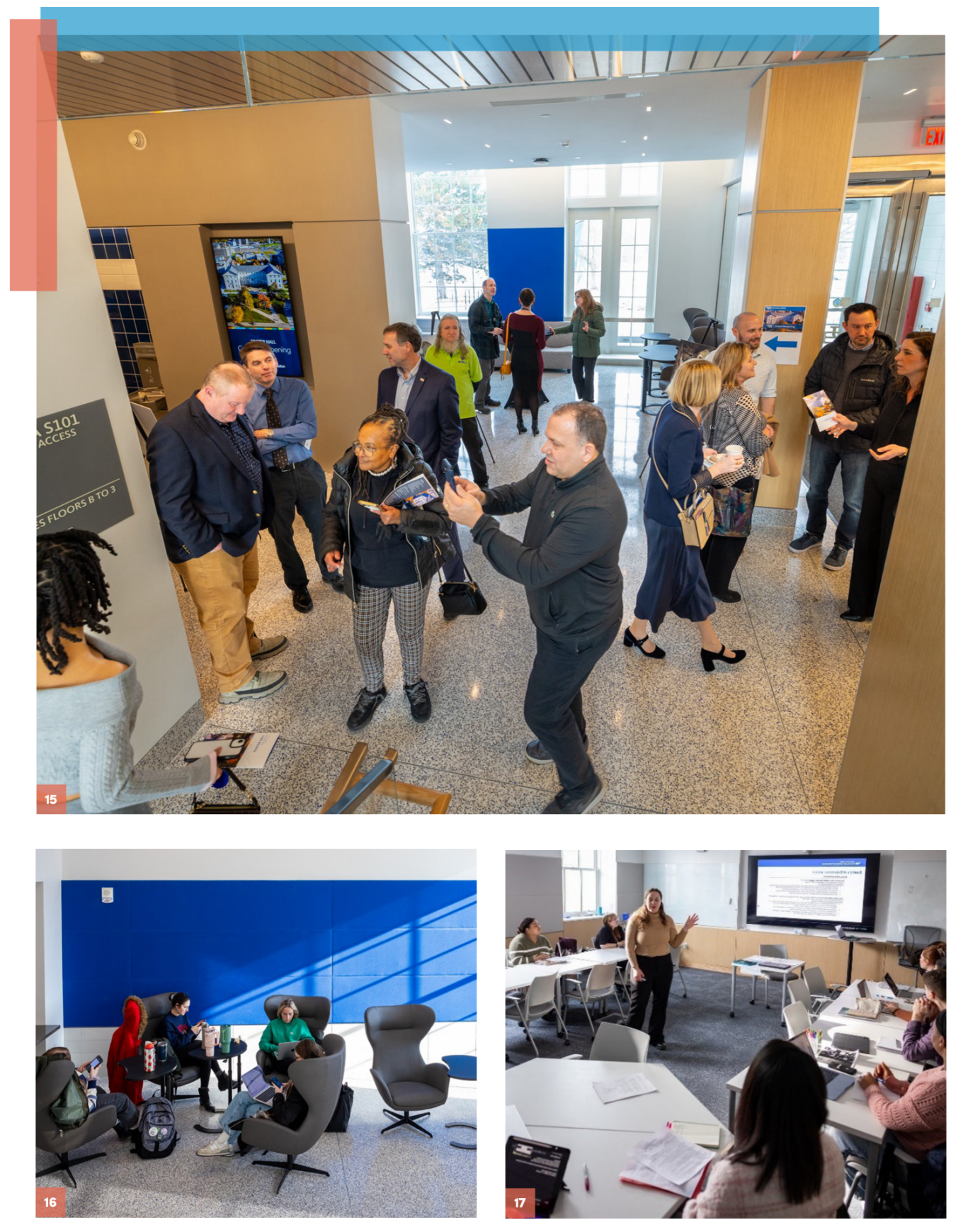
15. The GSE community gathers in Foster Hall’s front entry. | 16. Students sit in a lounge area on the second floor of Foster Hall between classes in January 2026. | 17. A Career Design Center consultant speaks with students in a Foster Hall classroom in January 2026.
GSE PhD student Tukhbita Nawmi recalls exploring the building for the first time, looking for the perfect place to study or relax. “The yellow seats in the corner of the second floor got my attention. I really do like the cozy vibe of that corner, and it’s next to the window with the view of [the Hayes Hall clock]. I love it.”
Foster’s more formal spaces are designed for flexibility. Conference rooms transform easily into classrooms or meeting spaces, while larger gathering areas support school-wide events and lectures.
For students moving between classes, labs and study spaces each day, the impact of those design choices is easy to feel. “I love this building. It’s bright. I feel like we’ve leveled up as a space,” said GSE doctoral student Abigail Henry. “There are so many quiet places to work, and the classrooms are great places to be a student and teach.”
Infrastructure for learning
Technology is another key feature of this renovation. Foster was rebuilt with a modern infrastructure designed to support hybrid learning, research and collaboration. Wireless connectivity has been upgraded throughout the building, and classrooms are equipped with advanced audiovisual systems.
“Instead of implementing the current campus technology standard for classrooms and conference rooms, we were able to push that standard forward,” explained Mike Tinsmon, GSE’s director of IT.

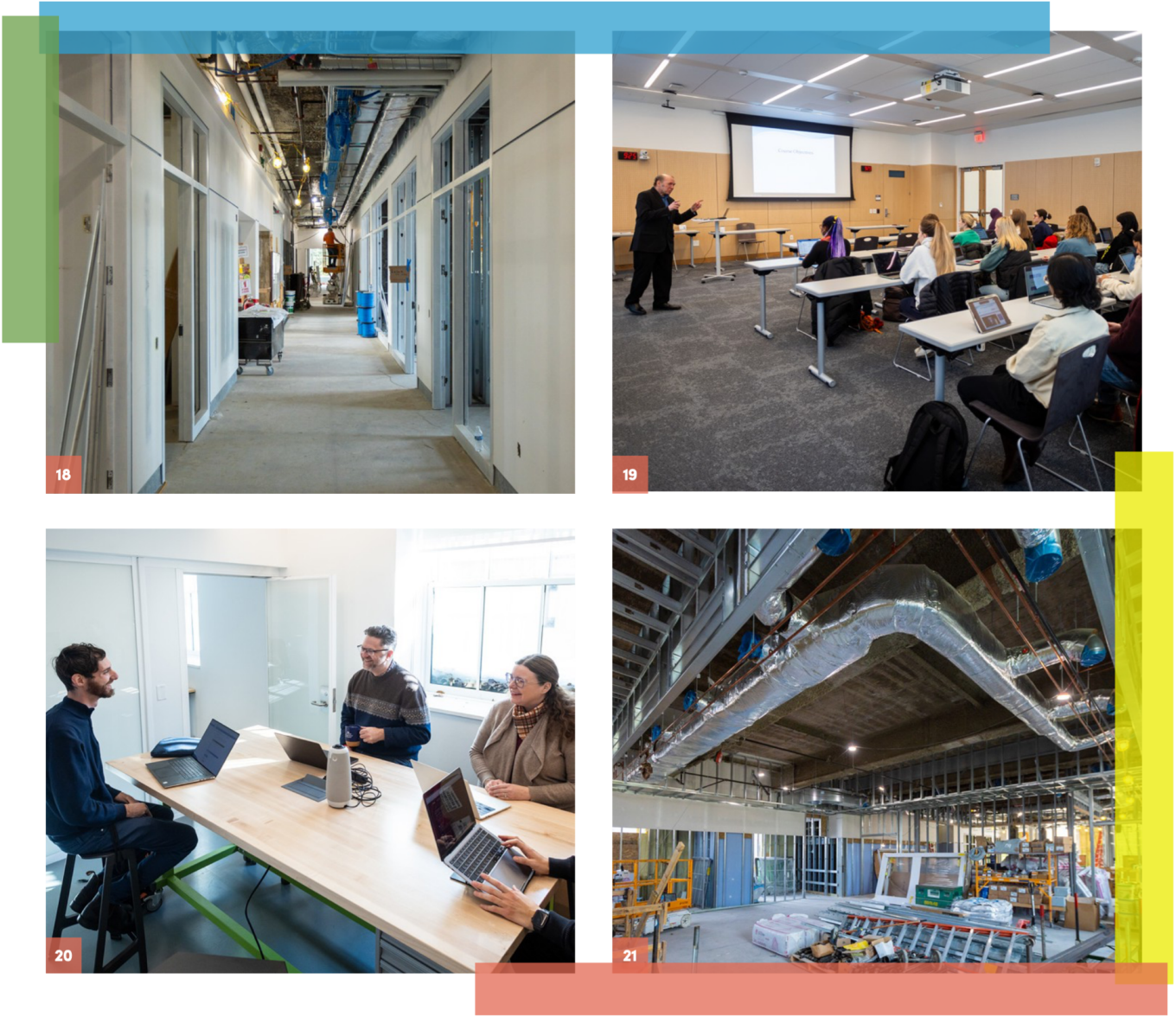
18. State-of-the-art wireless connectivity is installed in Foster Hall.
19. GSE Professor Myles Faith teaches a class in Foster Hall in January 2026.
20. GSE Professor Christopher Hoadley meets with a small group in a ground floor space in Foster Hall in January 2026.
21. The building’s transformation in progress, with new infrastructure, framing and interior systems taking shape.
Just as important as the technology itself is how it supports the broader student experience. The building offers prominent, visible spaces for GSE’s Alberti Center for Bullying Abuse Prevention, Center for K–12 Black History and Racial Literacy Education and Institute for Learning Sciences, among others.
“It means a great deal to us to have a dedicated space where students, faculty, staff and collaborators can gather to meet, exchange ideas and build community,” said Stephanie Fredrick, associate professor and associate director of GSE’s Alberti Center for Bullying Abuse Prevention. “Our work is highly collaborative, and having a centralized location enables us to connect and work together effectively as a team.”
That same sense of connection extends to the research happening throughout the building.
“On many campuses, teaching, research and outreach take place in separate spaces,” explained Christopher Hoadley, professor of learning and instruction and director of UB’s Institute for Learning Sciences. “But you really want those activities rubbing up against each other as often as possible.”
In Foster Hall, the Institute’s Learning Sciences Lab now serves as a flexible space for research, teaching and community programming. According to Rosenblith, the new facilities are already prompting conversations about expanding this programming, including youth-oriented initiatives such as summer camps that bring students and families onto campus.
Values made visible
From the outset, sustainability has been a central piece of the Foster Hall renovation.
The building has been integrated into the South Campus thermal-energy network, a cornerstone of UB’s Clean Energy Master Plan. The overhaul replaced aging infrastructure with a high-efficiency system designed to reduce emissions, while improving reliability and comfort inside the building. Foster is now considered a state-of-the-art facility with no scope 1 or 2 carbon emissions.
“Foster Hall is significant because it translates UB’s Clean Energy Master Plan from a roadmap into a real, occupied building,” said Tonga Pham, associate vice president for university facilities. “It demonstrates how campus‑scale strategies can be implemented at the building level in a way that is scalable, durable and directly supports UB’s long‑term decarbonization goals.”
That commitment was formally recognized in January 2026, when Foster Hall earned LEED Gold certification—UB’s tenth LEED Gold certified building.
“Foster Hall’s transformation from one of our oldest structures to a state-of-the-art net-zero carbon building is a testament to the commitment, value alignment and perseverance of University Facilities, the SUNY Construction Fund and the Graduate School of Education,” UB’s Chief Sustainability Officer Ryan McPherson said.
Behind the scenes, systems such as the building’s heat pump network, upgraded windows and long-lasting materials were selected to reduce environmental impact while maintaining stable, comfortable conditions across classrooms, offices and common areas.
“Foster Hall is significant because it translates UB's Clean Energy Master Plan from a roadmap into a real, occupied building.”
—Tonga Pham, Associate Vice President for University Facilities


22. BPS student artists’ 53- foot mural brings themes of hope, inclusion, education and democracy to Foster Hall’s main stairwell.
23. BPS students work with GSE community members to create a mural for Foster Hall in July 2025.
24. A ribbon-cutting ceremony marks the official reopening of Foster Hall. Pictured from left are BPS’s Michele Agosto, GSE doctoral student Sarah Hale, Provost A. Scott Weber, President Satish K. Tripathi, SUNY Trustee Eunice A. Lewin, GSE Dean Suzanne Rosenblith and Laura E. Hubbard, UB vice president for finance and administration.
25. BPS student artists stand in front of their mural in Foster Hall. Joining them on the stairs, from left, are Wil Green, GSE assistant dean of outreach and community engagement; local artist James Cooper III; Michele Agosto, BPS
director of arts; SUNY Trustee Eunice A. Lewin; UB President Satish K. Tripathi; and GSE Dean Suzanne Rosenblith.
26. Tripathi joins the UB community to celebrate the reopening of Foster Hall.
27. GSE Dean Suzanne Rosenblith speaks at ribbon-cutting ceremony.
The ‘city campus’ advantage
One of the greatest advantages of Foster Hall is its location. The building places GSE squarely within the city it serves. For a school whose work depends on partnership with K–12 schools, educators, families and community organizations, proximity is essential.
“With GSE’s public mission—serving and engaging with the community—it made sense that we are not tucked away in the middle of North Campus, but much more present within the community,” said Rosenblith. “We sit right at the nexus of Amherst and Buffalo, which makes this the right place to enact that mission.”
Being located on the South Campus along Main Street, with access to Metro Rail and NFTA bus routes, expands the notion of who can walk through GSE’s doors. Families, educators and community partners can more easily access programs and services in a space that is familiar and reachable. Meetings and events can take place in an area that feels open and accessible.
The alignment between location and mission reflects the university’s long-standing vision for the South Campus as a civic-facing academic environment that houses its professional schools, including GSE, the School of Architecture and Planning, and the School of Public Health and Health Professions.
That vision is the result of years of intentional planning and investment. “We’ve been methodically revitalizing the South Campus over time,” said Hayes McAlonie.
She explains that the revitalization has unfolded in phases—shaped in part by fluctuations in state funding—but guided by a long-term plan.
Projects such as Hayes Hall, Crosby Hall and improvements to surrounding buildings have steadily advanced that vision, reinforcing the campus as a hub for UB’s professional schools and community-facing work.
In particular, Foster Hall was designed to welcome the community inside. As part of the renovation, the interior palette was intentionally kept neutral to support the integration of public art throughout the space.
One early example of that approach now stretches across the building’s main stairwell.
Throughout the summer of 2025, Buffalo Public Schools students worked alongside GSE faculty and local artists to create a mural for Foster Hall that reflects themes such as hope, inclusion, education and democracy.
Guided by local visual artist James J. Cooper III, BPS Director of Arts Michele Agosto and art teacher Jackie Hart, a team of student artists researched UB’s history and GSE’s mission before translating those ideas into a large-scale design. The students—paid through the city’s summer youth program—worked as art apprentices. They learned drawing, design and painting techniques, while developing collaboration, communication and leadership skills.
The final mural weaves natural imagery, such as flowers and vines, and symbolizes the power of learning.
“Anytime we can create opportunities to break down barriers to higher education, that matters,” Rosenblith said. “If families come to campus to see their child’s artwork, that visit alone might help them feel that they—or their child—belong here.”
According to Cooper, GSE’s return to South Campus has made partnership more reciprocal.
“Access works both ways. On any given day, I can spend time with partners at local schools or community programs, and those same stakeholders can come to campus or use space in Foster Hall for meetings and activities,” he said. “Ideally, that type of traffic in and out of the building will foster connections that grow well beyond transactional collaboration.”
What Foster represents now
On Feb. 27, the UB community and its local partners gathered on the front steps of Foster Hall for a ribbon-cutting ceremony marking the building’s official reopening.
“The return of the Graduate School of Education to its original home in Foster Hall marks more than a relocation,” said UB President Satish K. Tripathi during his remarks. “It represents a bold step forward.”
Rosenblith shared his sentiments: “Foster Hall once turned inward. Today, it faces Main Street again. It is open. It is connected. And it is ready,” she said at the ceremony. “It is ready to support the work that will happen in classrooms and labs, in tutoring sessions and community meetings, in conversations that challenge assumptions and in partnerships that strengthen schools and neighborhoods.
“This building does not define us. But it does reflect us,” she added. “It reflects a school rooted in history, committed to community and focused squarely on the future.”
That future will be shaped by the conversations, partnerships and research happening inside. The walls are historic. The work ahead is not.
Foster Hall was built for this.
“Foster Hall once turned inward. Today, it faces Main Street again. It is open. It is connected. And it is ready.”
—Suzanne Rosenblith, GSE Dean and Professor
Historic Milestones
Foster Hall: GSE’s First Home
1921
Foster Hall opens on UB’s South Campus as the university’s first academic building along Main Street. Designed by McKim, Mead & White, the building is constructed with a $500,000 gift from philanthropist Orrin Elliott Foster.
1931
The School of Education is established. In its early decades, education programs are housed in Foster Hall, placing the school at the heart of UB’s city campus.
Mid-20th century
As UB grows, Foster Hall serves multiple academic units, including chemistry and
education, adapting to the university’s evolving needs.
1973
GSE moves from Foster Hall to Baldy Hall on the North Campus, reflecting expanded programs, faculty and research activity.
1973–2025
For more than 50 years, Baldy Hall serves as GSE’s academic home. Foster Hall continues to support UB’s mission, most recently housing classroom and research space for the School of Dental Medicine.
2025
Following a three-year, $41 million renovation, GSE returns to Foster Hall, now restored for a new era of teaching, research and community engagement.