Roaming the Halls Student Profile
Reading the warning signs: Inside Reza Nahid Sahlan’s research on eating disorders and suicide risk
BY DANIELLE LEGARE
When Reza Nahid Sahlan started graduate school in Iran, he thought he had a clear sense of where his studies were headed.
He explored borderline personality disorder, social phobia and bipolar disorder, reading widely, drafting proposals and continuing to look for a topic that felt like home.
But nothing quite clicked.
Then he came across a paper that changed his trajectory. The study explored body image among women who voluntarily chose to wear the hijab. The authors found that those women reported fewer body image concerns.
“I wondered: ‘What about my country?’” Sahlan said.
When he began studying Iranian women, he found the opposite pattern: heightened body image concerns and more eating disorder symptoms. That tension between cultural expectation, personal identity and mental health became the question he couldn’t put down.
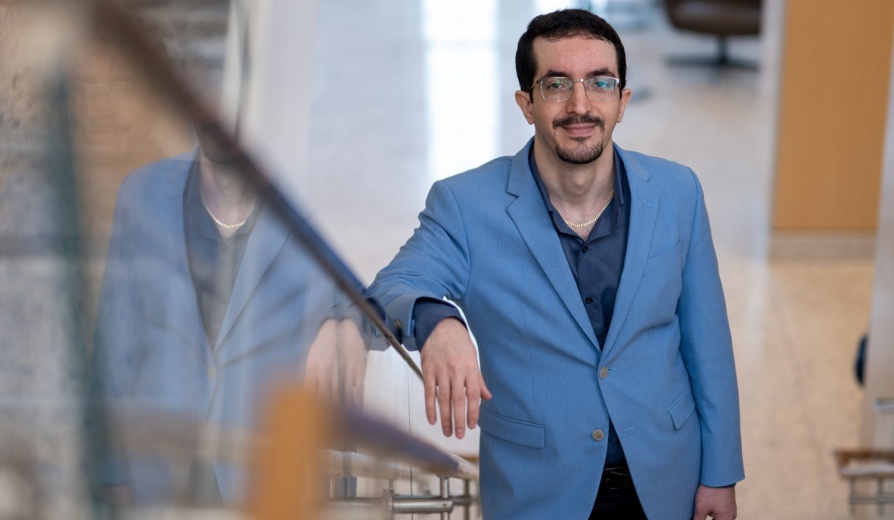
Today, Sahlan is a doctoral student in GSE’s counseling psychology and school psychology PhD program, where he is building a research career at the intersection of eating disorders, body image and suicide risk.

Where eating disorders and suicide risk intersect
One of his latest publications (Sahlan et al., 2025), in the journal Suicide and Life-Threatening Behavior, uses a statistical approach called latent profile analysis to look at how different patterns of eating disorder symptoms combine with suicide-related risk factors such as feeling like a burden, feeling disconnected from others and feeling more capable of acting on suicidal thoughts. Among 773 Iranian adults, Sahlan and his co-authors identified six distinct subgroups. The groups with both binge/purge-type symptoms and high levels of suicide risk factors had the greatest odds of suicide attempts
For Sahlan, the takeaway is both practical and scientific.
“If someone comes to therapy with suicidal thoughts, clinicians also need to ask about eating disorder symptoms,” he explained. “When both are present together, the risk can be much higher.”

Building a global research network
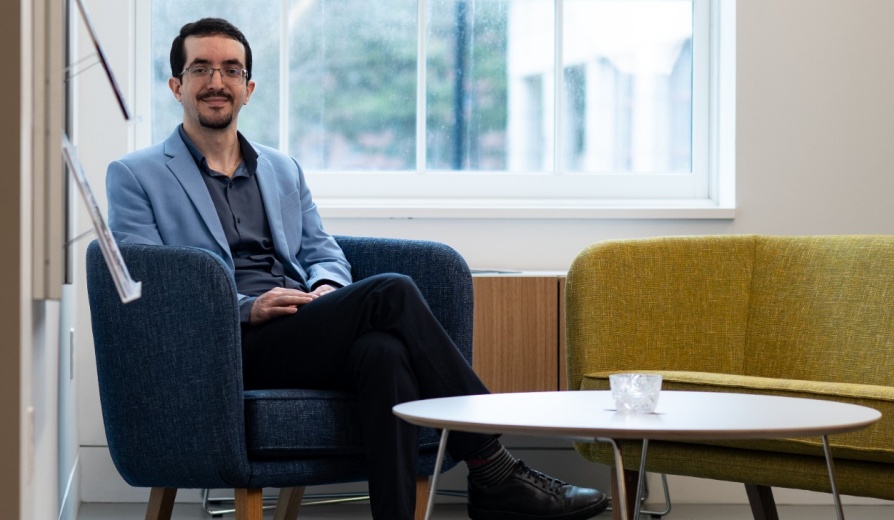
Although much of his early work centered on Iranian populations, Sahlan has steadily expanded his lens. He is now collaborating with faculty and students in UB’s Department of Psychology on a longitudinal study of UB college students, tracking how specific risk factors over time might predict eating disorder symptoms. He has also co-authored cross-cultural studies involving LGBTQ+ populations from universities in the U.S. and other countries, with collaborators in Europe, North America and Asia.
That global network didn’t happen by accident.
“In terms of research, it’s important to expand our networks,” he said. “I’m open to collaboration. I’m eager to learn from many colleagues and many teams. When I began doing research, I started working with professors from Canada, the United States and Australia. We need feedback from lots of people.”
Sahlan’s CV reflects that philosophy. He has already reviewed hundreds of manuscripts for more than 50 journals and served as a guest associate editor and conference abstract reviewer.
Outside of his studies, Sahlan tries to carve out time for his hobbies. He listens to pop music while he writes, unwinds with movies and likes to walk around Buffalo and play volleyball when his schedule—and the weather—cooperate.
“Everything about Buffalo is good,” he said with a laugh. “Except maybe the winter. Last year was … cold.”
In the future, Sahlan hopes to become an assistant professor in the U.S., where he can establish his own lab focused on eating disorders.
“I’m so happy I chose this field,” he said. “There is still so much we don’t know, and I want to keep answering those questions.”