Student Research Symposium
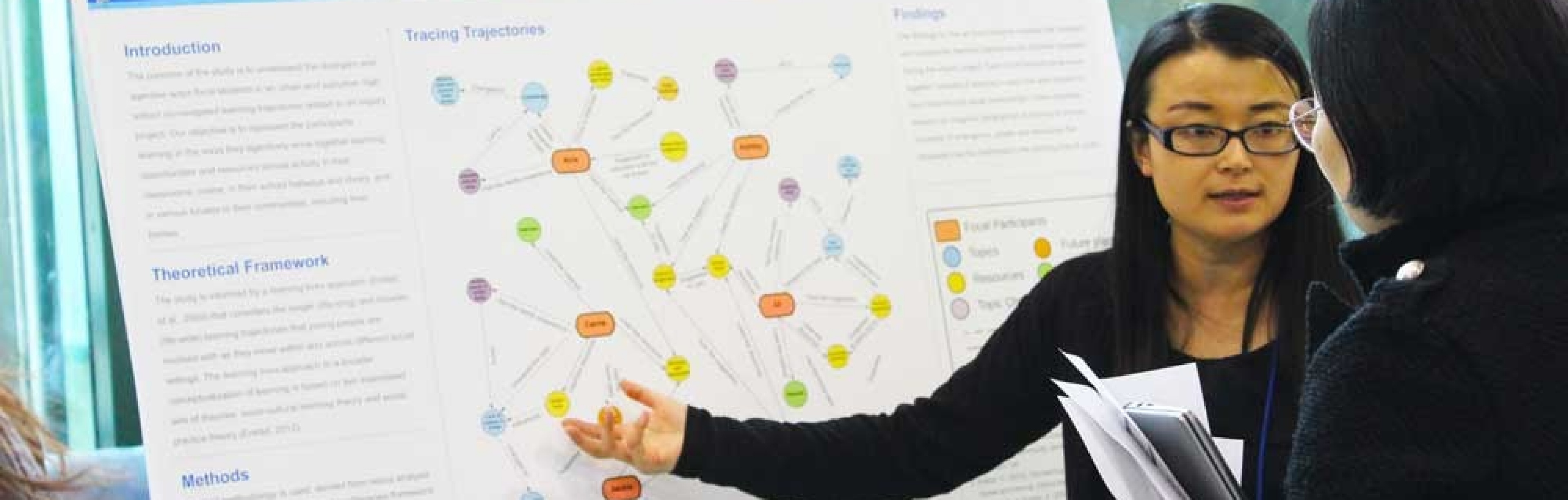
UB’s Graduate School of Education’s students showcase their work, explore their passion for research and strengthen their presentation skills. The annual Student Research Symposium is an opportunity for students from all disciplines within GSE to work collaboratively, share their research, meet professionals in their field and prepare for upcoming conferences. Students present research posters, papers and panels that share the symposium theme.
2026 Theme: “Human–AI Collaboration & Agency”
Tuesday, March 31, 2026
Location: Foster Hall (UB South Campus) and Online via Zoom
Sponsors: Department of Information Science, GSE Departmental Chapters of the Graduate Student Association, Graduate School of Education
GSE invites proposals to present original research at the annual GSE Student Research Symposium. The symposium theme will explore the collaboration of humans and AI in information, communication and education spaces. Students may submit proposals that examine the collaborative relationships between humans and AI, ethical engagement and integration of AI tools, the agency of humans when designing or using AI technologies, and practical experiences of AI implementation, or otherwise. We welcome submissions on any topic—including those unrelated to, or critical of, AI technologies—and at any stage of research.
Registration
At this time, we also invite all GSE students, faculty, staff, community members and alumni to RSVP for the Symposium. Free registration is required for attendance.
Service
All students and faculty are encouraged to consider serving as peer reviewers. Faculty are also invited to serve as moderators for sessions on the day of the symposium. If you can share your service generously, please get in touch with the symposium committee co-chairs or faculty advisor via email:
- Sasha Naples, sashanap@buffalo.edu
- Ava Cohen, acohen8@buffalo.edu
- Saguna Shankar, PhD, sagunash@buffalo.edu
Welcome Attendees
The Graduate School of Education (GSE) Annual Student Research Symposium explores the collaboration of humans and AI in information, communication, and education spaces. Students in the Graduate School of Education will present their original research that examines the collaborative relationships between humans and AI, ethical engagement and integration of AI tools, the agency of humans when designing or using AI technologies, and practical experiences of AI implementation, or otherwise. All submissions were welcome, regardless of topic and stage of research.
The symposium is sponsored by the Department of Information Science, departmental chapters of the Graduate Student Association, and the GSE at the University at Buffalo. We thank you for attending in person at Foster Hall or virtually via Zoom. We appreciate your support of the symposium and students in the GSE.
This program contains information about the symposium, including the schedule, keynote speaker, and poster, paper, roundtable and panel sessions with locations and Zoom links.
We hope you enjoy the symposium!
Sincerely,
The GSE Symposium Committee
Schedule
All sessions are on Tuesday, March 31, 2026. All times are Eastern Daylight Time.
Arrival
| Time | Activity | Location |
|---|---|---|
| 10:00-10:30 a.m. | In-person attendees are welcome to visit the sign-in desk for name badge and program. | Foster Hall main entrance — 101B & 128 |
Morning
| Time | Activity | Location | Zoom Link |
|---|---|---|---|
| 10:30 a.m. | Dean’s Opening: Suzanne Rosenblith | 135 Foster Hall | Join Session |
| 10:35 a.m. | Introduction to Keynote: Vadnana Sharma | 135 Foster Hall | Join Session |
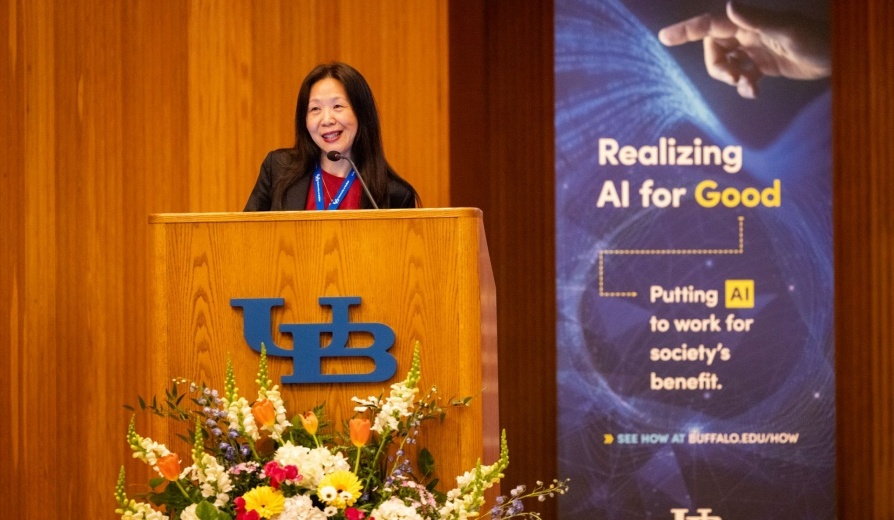
| 10:45 a.m. | Keynote: Ethics of Care in Designing AI and AI Education for and With Children — Dr. X. Christine Wang | 135 Foster Hall | Join Session |

Keynote Speaker
Professor of learning and instruction in the Graduate School of Education; director, Fisher-Price Endowed Early Childhood Research Center; senior associate dean for interdisciplinary research
Title of Session: “Ethics of Care in Designing AI and AI Education for and With Children”
Christine Wang's research examines how technology shapes young children's learning and development, which has attracted sustained funding from NSF, IES, Spencer and AERA. She currently leads the Center for Early Literacy and Responsible AI, a $10 million IES-funded national R&D center, and serves as Broader Impacts Lead of the $20 million NSF/IES National AI Institute for Exceptional Education. At UB, she also leads high-profile initiatives such as the AI + Education Learning Community Series and The Hub: A University–Community Innovation Ecosystem for AI Learning and Design.
Dr. Wang has authored over 100 scholarly publications, delivered more than 40 invited/keynote talks and over 100 conference presentations nationally and internationally. She served as associate editor of Early Childhood Research Quarterly (2016–2023) and editor-in-chief of Journal of Research on Childhood Education (2017–2019), and co-chaired the 2024 ISLS annual meeting. She is a recipient of the AERA 2007 Jan Hawkins Award and the 2025 UB President's Medal for outstanding contributions.
Artificial intelligence (AI) is rapidly becoming part of the sociotechnical infrastructure of education, shaping how information is presented, how feedback is delivered, and how authority is experienced in classrooms and beyond. As education is simultaneously shaped by AI and tasked with preparing learners to understand it, the ethical stakes are profound.
This keynote situates early childhood as both a boundary case and a high-stakes context for examining AI ethics in education. Young children cannot meaningfully consent to algorithmic systems, interpret complex data practices, or opt out of technologies embedded in their learning environments. Attending to this developmental reality sharpens what an ethics of care—centered on relationships, reciprocity, and responsibility—demands in both AI system design and AI education. If care is a structural commitment, how should it shape system architecture? What responsibilities do designers bear when infrastructures are invisible to learners? How can AI education cultivate agency and critical participation rather than compliance?
Drawing from her research and design work at the Center for Early Literacy and Responsible AI (CELaRAI), the National AI Institute for Exceptional Education (AI4ExceptionalEd), and the AI & Me: Learning by Designing initiative, this talk illustrates how ethical commitments can be embedded in the co-design of AI systems and AI learning experiences with children, caregivers and educators. At a moment when many in education respond to AI with critique or resistance, I argue we must instead claim a meaningful role in shaping the infrastructures that determine how AI is built, implemented and understood, ensuring these systems protect dignity, sustain relationships and support learners’ agency.
Lunch
12:00–12:30 p.m. in 135 Foster Hall
Afternoon
| Time | Activity | Location | Zoom Link |
|---|---|---|---|
| 12:45–1:35 p.m. | Paper Session 1 | 301 Foster Hall | Join Session |
| 12:45–1:35 p.m. | Paper Session 2 | 229 & 230 Foster Hall | Join Session |
| 12:45–1:35 p.m. | Panel 1: What Students Talk About, and What They Don't: Navigating Institutional Support Systems | 135 Foster Hall | Join Session |
| 1:50–2:40 p.m. | Paper Session 3 | 301 Foster Hall | Join Session |
| 1:50–2:40 p.m. | Paper Session 4 | 229 & 230 Foster Hall | Join Session |
| 1:50–2:40 p.m. | Panel 2: Lived Experiences of Connecting With Educational Institutions Across Race and Gender | 135 Foster Hall | Join Session |
| 2:55–3:45 p.m. | Paper Session 5 | 301 Foster Hall | Join Session |
| 2:55–3:45 p.m. | Roundtable | 229 & 230 Foster Hall | Join Session |
| 2:55–3:45 p.m. | Panel 3: Research, Relationships, and University-Assisted Community Schools: A Conversation | 135 Foster Hall | Join Session |
| 4:00–4:50 p.m. | Paper Session 6 | 301 Foster Hall | Join Session |
| 4:00–4:50 p.m. | Paper Session 7 | B38 Foster Hall | Join Session |
| 4:00–4:50 p.m. | Panel 4: Asian Students' and Teachers' Experiences, Perspectives, and Voices in Transnational Educational Contexts | 135 Foster Hall | Join Session |
| 5:00–6:00 p.m. | Poster Session | Second-Floor Learning Landscape and Hallway, Foster Hall | In-Person Only |
Paper Session 1
- Faculty Moderator: Dr. Samuel Dodson
- Time: 12:45–1:35 p.m.
- Location: 301 Foster Hall | Join Zoom Session
Papers
- When the Tool Gazes Back: A Critical Review of Power Dynamics in Teacher-GenAI Interaction
Authors: Zhehan Zheng, Mary McVee, and Jingning He - University-Level Policies on Artificial Intelligence: Lack of Training and Guidance
Authors: Kylee A. Healy, Ali Sajjad, and Dr. Melinda Lemke - Closing the Door to Extralegal Information Gathering at the California Department of Motor Vehicles
Author: Ashley Hankins [virtual presenter]
Paper Session 2
- Faculty Moderator: Dr. Kristin Cipollone
- Time: 12:45–1:35 p.m.
- Location: 229 & 230 Foster Hall | Join Zoom Session
Papers
- The Recognition-Action Gap: Why Curriculum Leaders Cannot Act on AI Integration Challenges in K-12 Education
Authors: Junye Guo and Kristen Smigielski - Evaluating an NIH-funded STEM Intervention Using Second-Order Structural Equation Modeling
Authors: Weiyi Ding, Sunha Kim, Stephen Koury and Sandra Small - Architectural Signatures for Cognition: A Galileo Framework for Comparing Priming Effects Across Human and Artificial Intelligent Systems
Authors: Emary Iacobucci and Joseph Woelfel
Paper Session 3
- Faculty Moderator: Dr. Mary McVee
- Time: 1:50–2:40 p.m.
- Location: 301 Foster Hall | Join Zoom Session
Papers
- An Examination of the Privacy Policies of Generative Text AI and How to Protect Students’ Privacy in a Higher Education Setting
Author: Ashlie Morrison [virtual presenter] - AI Leadership Climate Shaping Computational Thinking: Evidence from ICILS 2023 in Korea
Author: Tukhbita Afroz Nawmi - AI as a Translanguaging Partner in Multilingual Adult ESL Classroom
Author: Najat Sghyar - Non-Discriminatory AI Recruiting Policy
Author: Kristen Walker [virtual presenter]
Paper Session 4
- Faculty Moderator: Dr. Sunha Kim
- Time: 1:50–2:40 p.m.
- Location: 229 & 230 Foster Hall | Join Zoom Session
Papers
- Thinking ahead to succeed: Episodic Future Thinking decreases Delay Discounting in First-Generation College Students
Authors: Ashfique Rizwan, Emily Barone, Myles S. Faith, and Leonard H. Epstein - Resisting the Neoliberal University: Mixed-Methods Insights on Marginalized Student Activism and Transformational Resistance
Author: Sarah Anne Hale - An Examination of the College Decision-Making Experiences of Adult Student Parents
Author: Ryan Taughrin - Claiming Space in the Margins: Legitimacy, Trust, and Growth in Fat Studies Research
Author: Sara Kieffer
Paper Session 5
- Faculty Moderator: Dr. Dan Albertson
- Time: 2:55–3:45 p.m.
- Location: 301 Foster Hall | Join Zoom Session
Papers
- Assessing Engagement in Early Literacy Apps: A Rubric for Practitioners and Caregivers
Author: Grace Y. Xu - Neuroscience Informed Professional Development and how it shapes K–12 Teachers’ Instructional Practices and Identity
Authors: Pakmoni Lariba, Paris Wicker, Jessica Chatonda, and Marlen Gonzalez - Leveraging Artifactual Scaffolds to Integrate Translanguaging and Engineering Design in Multilingual Third-Grade Classrooms
Authors: Jingning He, Mary McVee, Yueqiu Zhang, Dameeni Lagad, Duncan Mullins, and Jessica Swenson
Paper Session 6
- Faculty Moderator: Dr. Yilang Zhao
- Time: 4:00–4:50 p.m.
- Location: 301 Foster Hall | Join Zoom Session
Papers
- Leveraging Linguistic Landscape in the Teacher Education: Cultivating Critical Multilingual Minds for Pre-service Teachers
Author: Ziqi Li - Exploring CFL Teacher Identity through Podcasts: Positioning, Agency, and Social Justice in Cross-Cultural Contexts
Authors: Jingning He and Zhehan Zheng - Effects of ACCESS Reading on Foundational Reading Skills in Grades K-2
Authors: Maureen Bender and Anthonia Ojeh - Thinking Routine with AI: A Middle Schooler's Case Study
Author: Tukhbita Afroz Nawmi
Paper Session 7
- Faculty Moderator: Dr. Virginia Flood
- Time: 4:00–4:50 p.m.
- Location: B38 Foster Hall | Join Zoom Session
Papers
- Data Veracity as a Catalyst for Perceived Reliable Library Services Among Graduate Students
Author: Aloysius Senono Mwanje - Exploring the Impacts of Social-Emotional Learning (SEL) on Mathematics Achievement and Emotional Development in Chinese Societies and the United States: Evidence from PISA 2022
Author: HuiHsuan (Shana) Liu - Family Dynamics, Parental Involvement, Behavioral Patterns, And Student Success: A Structural Equation Modeling Investigation Using National Survey Data
Author: Weiyi Ding - Does Internet Use Influence Science Performance Directly and Indirectly Through ICT Self-Efficacy and Science Self-Efficacy?
Authors: Hyeonji Jeong, Sunha Kim, Wei Wang, Dris Prophete, and John E. Slaughter
- Faculty Moderator: Dr. Nathan Daun-Barnett
- Time: 2:55–3:45 p.m.
- Location: 229 & 230 Foster Hall | Join Zoom Session
From AI-Supported ESL Writing to Co-Researchers: Empowering Refugee Youth Through YPAR
Author: Muhammad Ahmad
Wearable Technology in Physical Education: Effect of Step Counters on High School Student Motivation
Author: Naiyyir Hossain
“Invisible Newcomers”: First-Generation Burmese Refugee Students Planning Life After High School
Author: Ngo Hna
Panel 1
What Students Talk About, and What They Don’t: Navigating Institutional Support Systems
Authors: Joyce Adeola Jekayinoluwa, Karly Rakhim, and Naomi Maria Smith-Perrone
- Faculty Moderator: Dr. Amanda Winkelsas
- Time: 12:45–1:35 p.m.
- Location: 135 Foster Hall | Join Zoom Session
Panel 2
Lived Experiences of Connecting With Educational Institutions Across Race and Gender
Authors: Jessica Chatonda, John Slaughter, and Shay Valley [hybrid panel]
- Faculty Moderator: Dr. Paris Wicker
- Time: 1:50–2:40 p.m.
- Location: 135 Foster Hall | Join Zoom Session
Panel 3
Research, Relationships, and University Assisted Community Schools: A Conversation
Panelists: UB GSE Graduate Students (Muhammad Ahmad, Oluwabunmi Alao, Nish Chowdhury, Abigail Henry, Cate Keenen, Ziqi Li, Anna Stukes, Abdelhamid Touti), Research Lab High School (BPS) Students and Faculty
- Facilitators: Dr. Tim Monreal, Dr. Kristin Cipollone
- Time: 2:55–3:45 p.m.
- Location: 135 Foster Hall | Join Zoom Session
Panel 4
Asian Students’ and Teachers’ Experiences, Perspectives, and Voices in Transnational Education Contexts
Authors: Winter Linch, Sharon Jessica, Ray Shi, Maggie Ma [virtual presenter], and Fuyi Feng [hybrid panel]
- Faculty Moderator: Dr. Jinting Wu
- Time: 4:00–4:50 p.m.
- Location: 135 Foster Hall | Join Zoom Session
All posters will be available for in-person viewing on the Second-Floor Learning Landscape and Hallway, Foster Hall, throughout the event. From 5 to 6 p.m., one or more of the poster authors will be present to discuss their work.
- Perceived Educational Preparation and Learning Modality as Predictors of Job Satisfaction and Retention among LIS Professionals
Authors: Aloysius S. Mwanje, Blessed A. Mhungu, Mercy W. Monde, Shuvo Kundu, Leisha Gordon, and Sunha Kim - Understanding Evolving Sexual/Gender Minoritized Identities Through a Qualitative Lens
Authors: Amy L Reynolds and Robyn Lelito - Beyond One-Size-Fits-All: Responsive Instruction Through Learning Preferences in Undergraduate STEM Education
Author: Dima Abass - Evaluating AI-Supported Early Literacy Applications: A Multi-Domain Rubric
Authors: Grace Xu, Celine Krzan, Zhuoyun Joy Cai, Jillian Johnson, and Tukhbita Nawmi - Exploring Public Library Patrons’ Digital Reading Experiences and Information Behaviors in Human–AI Assisted E-Book Environments
Author: Jessica (MinKyung) Baek - Generative Artificial Intelligence Practices Among Major Educational Groups in the United States
Authors: Jesus Montiel, Shuvo Kundu, Nicole Schlater, Leigh McLean, and Mary McLean - Examining the Relationship Between Digital Citizenship and Problematic Media Use Among Sixth-Grade Students
Authors: K. Brown, R. Godwin, B. Mask, H. Rapp, S. Rourk, A. Nickerson, and S. Fredrick - Warmth and Dominance Dimensions Predicting Offense Type in Forensic Psychiatric Population
Author: Margaret Youngs - “I fear giving them wrong information.’’ Exploring Consumer Health Information Provision in Selected Public Libraries: A Pilot Study
Author: Mercy Wamunyima Monde - Girls on the Run and Positive Youth Development: A Review
Authors: Molly D. Moore and Myles S. Faith - Between Tool and Agent: Rethinking Artificial Intelligence and Agency in Second Language Acquisition
Author: Najat Sghyar - The Mentorship, Advocacy, Power, and Support (MAPS) Scale: Developing a comprehensive measure of mentoring dynamics
Authors: Wendy Guyker, Rachel Hechinger, Viola Hezardastan, Jahare Hudson, and Deniz Inanici - Gender Difference in Cyberhate Exposure and Coping Skills among Adolescents
Authors: Rahnuma E Jannat and Stephanie Fredrick - Cyberhate, Internalizing Problems and the Moderating Role of Family Support
Authors: Rahnuma E Jannat, Stephanie Fredrick, and Riley Godwin - Body Image and Psychosomatic Symptoms Among Adolescents in Slovenia
Authors: Reza Nahid Sahlan and Myles Faith - Cybervictimization and Disordered Eating Behaviors in Adolescence: A Conceptual Model of the Moderating Role of Highly Visual Social Media
Authors: Riley P. Godwin and Stephanie S. Fredrick - What Students Seek and Feel About AI: Beyond the Ordinary
Author: Shuvo Kundu - Social Media Use and Reinforcer Pathology in Adolescent Obesity: A Twin Study
Authors: Silvia Zumaglini and Myles Faith - Current Guidance for Coaches on Preventing/Identifying Eating Disorders in Athletes
Authors: Tory Watnick, MSEd, and Dr. Catherine Cook-Cottone, PhD - The Effects of Episodic Future Thinking on Delay Discounting and Hope in LAI203 College Students on Academic Probation
Authors: Yan Yan Sze, Myles Faith, Vivian Jimenez, Lauren Galgovich, Tyler Richards, Katelyn Carr, and Leonard H. Epstein - Creating and Sustaining Well-being Support for Black and Indigenous Students in Higher Education
Authors: Yang Ming (Albert) Chen and Paris Wicker - The Multiple Moral Orders of School Leaders in Seeking a “Happy Medium” in K–12
Authors: Zhuoyun Joy Cai and Celine Krzan - Weight Restoration in Atypical Anorexia Nervosa: A Systematic Review
Authors: Rachel Hechinger, Molly Robbins, and Catherine Cook-Cottone
Graduate School of Education Symposium Committee
- Co-Chair: Sasha Naples
- Co-Chair: Ava Cohen
- Faculty Advisor: Dr. Saguna Shankar
Members
- Albert Chen
- Aloysius Mwanje Senono
- Blessed Mhungu
- Grace Xu
- Ian Blyth
- Jake Lis
- Jasjit Multani
- Jessica Baek
- Jessica Chatonda
- John Usseglio
- Karly Rakhimova
- L Bates-Rodriguez
- Melinda Wallington
- Mercy Monde
- Ngo Hna
- Shana Liu
- Simone Saunders
- Vandana Sharma
- Vi Trinh
- Weiyi Ding
Acknowledgments & Thanks
We gratefully acknowledge the following individuals for their support:
- Amanda Winkelsas
- Amber Winters
- Aprell Scott
- Arryonna Singleton
- Bob Perini
- Dan Albertson
- Dawn Haak
- Georgia Bressner
- Howard Schumacher
- Jennifer Marshall
- Jianqiang Wang
- Kaya Karcker
- Kristin Cipollone
- Mary McVee
- Mary Jo Sicurella
- Michael Tinsmon
- Minghui Zhu
- Nathan Daun-Barnett
- Oluwabunmi Alao
- Paris Wicker
- Phyllis Rauch
- Samuel Dodson
- Sunha Kim
- Virginia Flood
- William Belz III
- Yilang Zhao
Important Dates and Deadlines
- Please submit your proposal information, including the required abstract as a PDF file of no more than 500 words, by the due date of 11:59 p.m. ET on Feb. 6, 2026.
Presentation Eligibility
- Must be a currently enrolled full- or part-time student at the University at Buffalo
- Presentations should be an original piece of research (e.g., empirical studies, theoretical position papers, professional development programs, explorations of a model, students’ research component or dissertation)
- Presenter(s) should have played a principle role in the research
- Online students are invited to submit virtual presentations; depending on the number of submissions and submission type, a hybrid or virtual access option can be made available
- 9 a.m. | Posters Available
- 9 – 9:50 a.m. | Panel Session 1
- “I, Too, Am A Student”: Narrations Related to Minoritized Experiences Within a Range of Educational Spaces
- Norms and Bystander Intervention Training (NAB IT!) for Bullying and Sexual Harassment Prevention in High School
- 10 – 11 a.m. | Keynote Presentation
Dr. Tish Jennings, University of Virginia - 11:20 – 11:50 a.m. | Concurrent Paper Session A
- Narrow the Completion Gap Through Best Practices for At-Risk Student Advisement
- The Urgent Threat of Lead Poisoning in the COVID-19 Era: A Renewed Call for Action
- Academic Research Libraries, Academic Capitalism, and Public Good(s): New Infrastructure for Knowledge
- First Generation Student Success (Part 1, Lathan/Iftin, Say/Davis)
- 12 – 1 p.m. | GSE Brown Bag lecture with Richard Arum, PhD
Separate registration is required - 1:30 – 2 p.m. | Concurrent Paper Session B
- The Nature and State of Practical Work in Science at Lagos State Public Secondary Schools: An Exploratory Case Study
- The Effects of Microaggressions on Transgender and/or Nonbinary Undergraduate Student Performance
- The Academic Playbook: Learning Strategies Utilized by Academic Coaches with Student-Athletes
- First Generation Student Success (Part 2, MacDiarmid and Rosalis/Davis)
- 2:15 – 2:45 p.m. | Concurrent Paper Session C
- Charter School Teacher Perceptions of College Readiness
- LGBTQ+ Pride & Daily Challenges: Intersecting Marginalized Identities
- “The American Dream”: Benchmarking excellence in inclusive higher education
- Active Learning Techniques to Promote Understanding of Shared Governance and Trust Among Diverse Stakeholders in Myanmar: A Research Proposal
- 3 – 3:50 p.m. | Poster Sessions
- Trauma Informed Mind-Body Wellbeing Program: A Controlled Trial of a Yoga-Based Program to Reduce Trauma Symptoms and Promote Wellbeing in Rwanda, Africa
- The Correlation Between Graduation Rates, Drop Out Rates and Exempt Status on New York State Regents Examinations
- Implementation of an Evaluation Mindset in School Crisis Response
- Good or bad? –How TikTok Affects The Lives of School-Age Left-Behind Children in China
- The Role of Priming in Assessment: Severity of Priming event as Predictor of Spanish Version Brief COPE Scores
- Should Programming Languages Hang on English?:
- “I think a lot of kids could have progressed further, but was that the point of the game?”: Exploring Considerations from Preschool Teachers of a Gamified Tablet Assessment of Executive Functioning
- “They’re such a QT-POC”: An Intersectional Exploration of the Lives of LGBTQ People of Color
- Humor as a Psychological Construct: Underlying Structure and Emotional, Interpersonal, and Coping Correlates
- Mindful Self-Care, Coping, and Meaning in Life: An Examination of the Professional Quality of Life and Well-Being among Professionals who Support and Provide Services to Refugees
- 4 – 4:30 p.m. | Concurrent Paper Session D
- Exploring Definitions and Perceived Value of Experiential Learning at an American University in Singapore
- Conservative Campus Engagement Through Social Movements in Higher Education
- An Inductive Approach to Designing Induction Support for Graduates of an Urban Teacher Residency Program
- 7 – 8 p.m. | Panel Session 2
- Investigating How Preservice Teachers Respond to History-Embedded Mathematics on the Learning of Functions
- Conducting Educational Research with IPA (Not the Beer): Two Examples from LAI
Submit a Proposal
Submissions will be read in a masked review process. Proposal reviewers will look for strength, accuracy and originality in research.
Proposals will be reviewed as they are received, so early acceptance is possible. Proposals received after the due date but before the schedule is released will be considered only if space is available in the symposium schedule.
It is recommended that each first author make a maximum of two submissions by completing them via the link below. Abstracts should be no more than 150 words
Questions about the proposal process?
Contact the symposium planning committee or faculty advisor through email:
- Sasha Naples - sashanap@buffalo.edu
- Ava Cohen - avacohen8@buffalo.edu
- Saguna Shankar, PhD - sagunash@buffalo.edu
About the Symposium
At UB, we constantly strive to inspire innovative ways for students to bridge the gap between research and practice.
The symposium, which features the work pursued by students throughout the Graduate School of Education, gives students a valuable opportunity to discuss their ideas in a scholarly environment.
Through this event, students can:
- Make connections with other students and professionals in their field
- Present and discuss their research in a professional, welcoming forum
- Enhance their professional development
- Prepare for regional, national and international conferences that are important to their field of study
2026-2027 Symposium Details
Details about the 2026-2027 Symposium will be released in the fall. Check back for more details.