
Published March 24, 2026
BY DANIELLE LEGARE
UB forum explores “hard challenges” for AI in education ahead of National AI Literacy Day
As National AI Literacy Day approaches on March 27, University at Buffalo Graduate School of Education researchers, educators and community partners are looking beyond what artificial intelligence can do quickly and asking a harder question: What challenges are worthy of sustained research, cross-sector partnership and long-term investment?
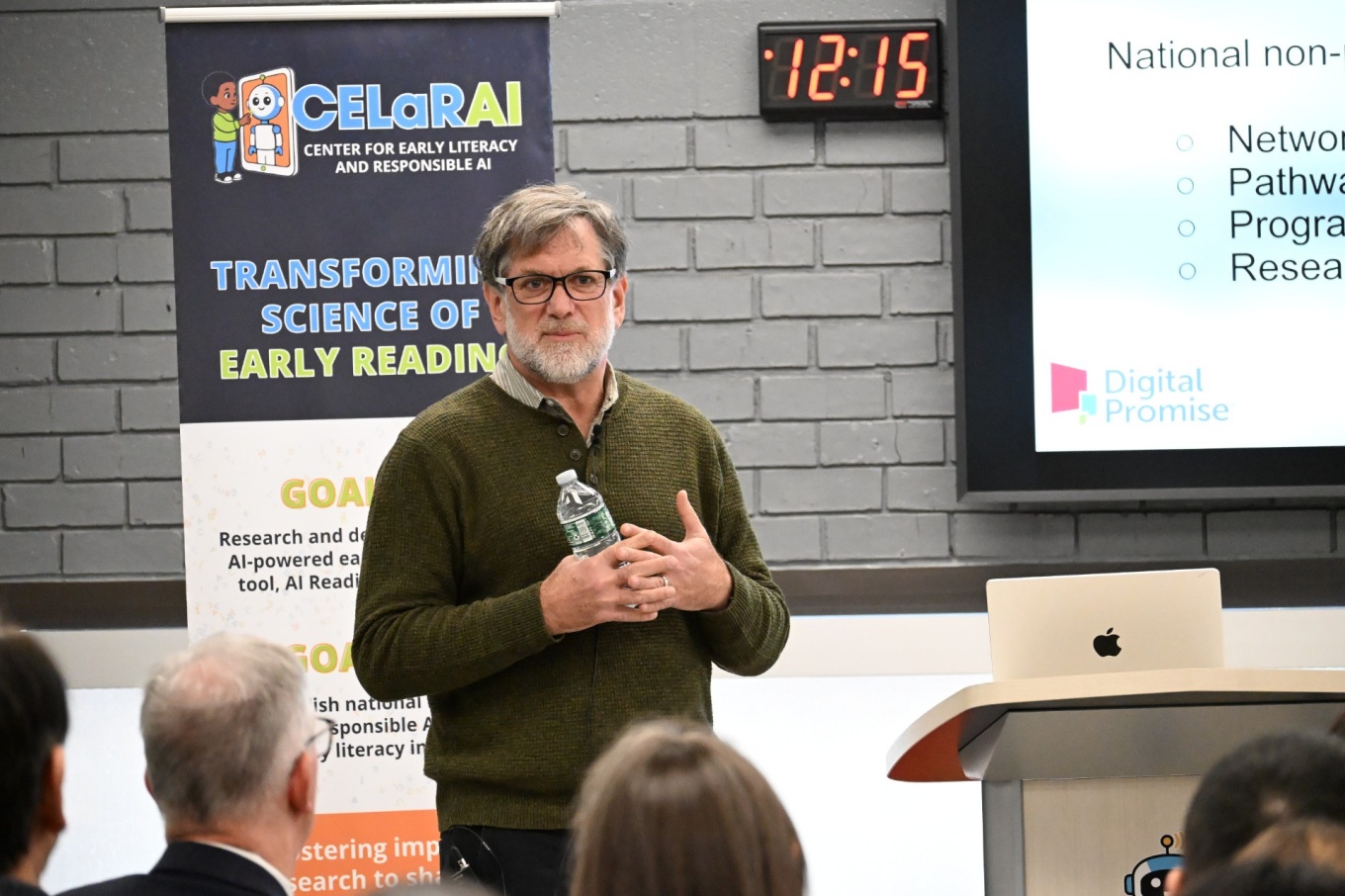
That question anchored the Center for Early Literacy and Responsible AI (CELaRAI)’s inaugural quarterly forum series, which launched in February with a campus visit from Jeremy Roschelle, executive director of learning sciences research at Digital Promise.
The visit included a GSE faculty conversation on Feb. 11, a public forum on Feb. 12 and a career-focused session for UB graduate students and postdocs later that afternoon.
CELaRAI is a $10 million Institute of Education Sciences-funded research center housed at UB’s Graduate School of Education. Led by X. Christine Wang, professor of early education and learning sciences and senior associate dean for research at GSE, the center focuses on integrating generative AI into early literacy education responsibly and effectively, with particular attention to young learners and culturally and linguistically diverse students.
“At a moment when AI is already reshaping K–12 classrooms, often faster than research and policy can keep up, it is imperative that universities like UB step forward to help shape the conversation responsibly,” said Wang. “Convening researchers, educators, technologists and community partners around early literacy ensures that AI development is grounded in evidence, equity and care. Through CELaRAI, UB is not just participating in national dialogue; we are helping define what responsible AI in early literacy should look like.”
A visit designed for faculty, students and community partners
Held in Foster Hall on Feb. 11, the GSE faculty conversation created space for an interactive discussion about emerging national research directions in AI and education and the role schools of education can play in shaping public infrastructure for AI.
The visit continued with the public forum the next day in the National AI Institute for Exceptional Education on North Campus, co-hosted by CELaRAI and GSE. In welcoming remarks, UB Provost A. Scott Weber underscored the significance of CELaRAI’s interdisciplinary mission, which connects learning sciences, early literacy research, artificial intelligence and ethics.
Beyond “quick fixes”
Roschelle’s talk, “AI and Education: Identifying Hard Challenges Worthy of Sustained Partnerships,” urged attendees to focus less on novelty and more on the conditions that make AI tools trustworthy, useful and scalable for real classrooms.
“There are ways to involve teachers in the generative AI process that can feel very empowering to them… It's not the end of the story of trust and transparency, but it's up to all of us to work harder on how we make teachers our partners in design,” Roschelle said.
He organized his remarks around three “hard challenges” he believes the field must tackle with seriousness and staying power:
- Building trust and transparency with educators and communities
- Creating shared benchmarks and public infrastructure that reflect learning science and help raise the bar for AI-enabled educational tools
- Scaling research-based improvements responsibly, including through partnerships with tools already used widely in schools
In describing what trust can look like in practice, Roschelle highlighted an approach that keeps teachers “in the loop” as co-designers, with opportunities to review, revise and approve content before students ever see it. Rather than treating AI as a black box, he argued that educators should be able to audit and understand how systems operate and identify their limitations.
The public forum also featured reflections from Brian Graham, superintendent of Grand Island Central Schools, and Jeffrey Botteron, president and CEO of TechBuffalo, who offered perspectives from K–12 leadership and the regional tech and innovation ecosystem. Both emphasized the importance of aligning AI adoption with real needs in schools and communities and echoed Roschelle’s point that trust and explainability are critical to long-term uptake.
Career pathways for graduate students and postdocs
Roschelle’s visit concluded with a Graduate Student and Postdoc Session on Feb. 12, where he spoke with UB graduate students and postdoctoral scholars about alternative career pathways in the education innovation ecosystem. The discussion explored roles in nonprofit research institutes, learning sciences organizations, philanthropic initiatives and public-interest technology and how those paths compare with academic careers.
“Bringing together leaders like Jeremy Roschelle, district superintendents, industry partners and federal funders in one room signals that responsible AI in early literacy is both a national priority and a local commitment,” Wang said.
“Forums like this build momentum by connecting research to practice and policy, strengthening partnerships that will sustain long-term innovation,” she added. “At this moment, UB and GSE have both the opportunity and the responsibility to lead thoughtfully, ensuring AI augments teachers and advances equitable literacy outcomes for our youngest learners.”
CELaRAI Quarterly Forum Series
Tuesday News Briefs feature the stories of the Graduate School of Education faculty, students and alumni who are engaged in their communities and making an impact through their hard work, dedication and research initiatives. If you have a story to share, please email us with the details for consideration as a future news feature. | Email Us Your Story