
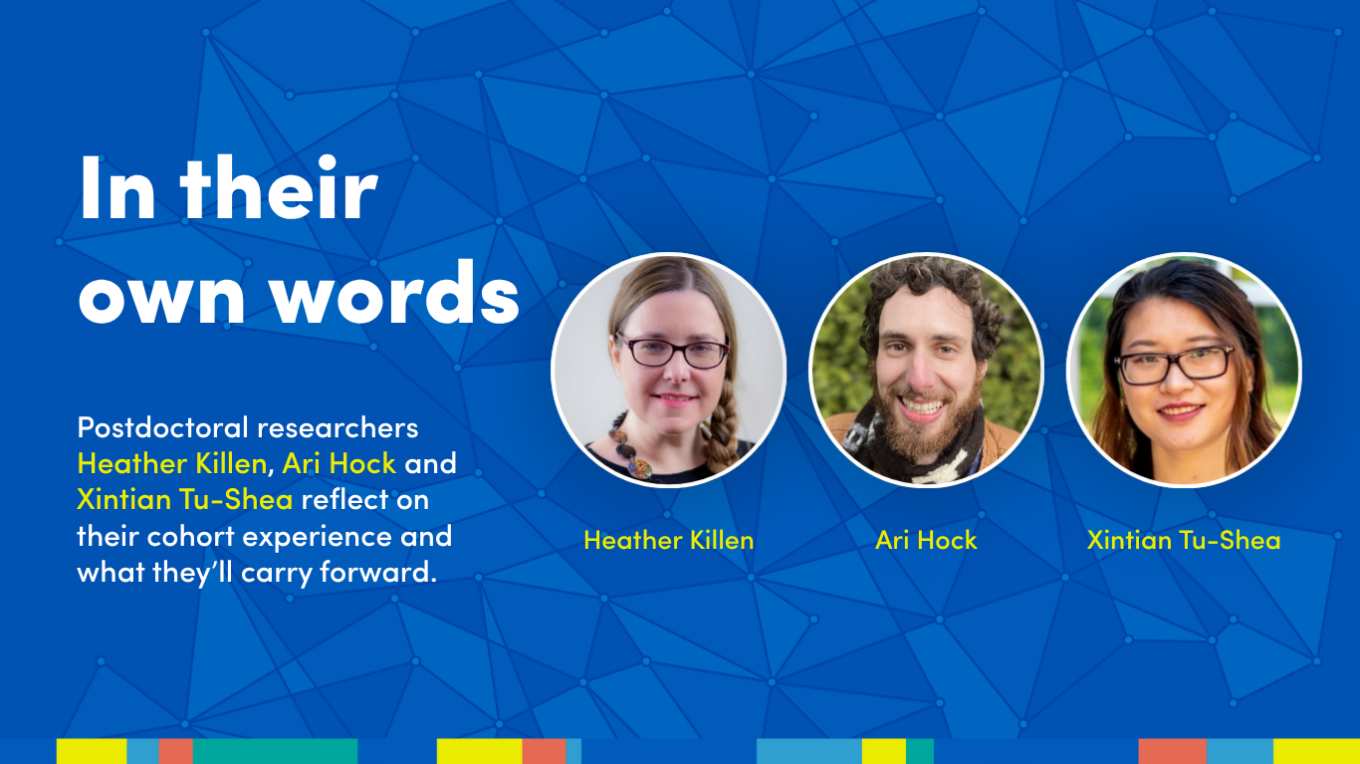
Heather Killen, Ari Hock and Xintian Tu-Shea discuss the work, relationships and lessons that shaped their postdoctoral appointments with the Institute for Learning Sciences.
Published July 24, 2026
BY DANIELLE LEGARE
In their own words: GSE postdoctoral researchers look back at two years at GSE’s Institute for Learning Sciences
Over the past two years, Heather Killen, Ari Hock and Xintian Tu-Shea have contributed to the University at Buffalo’s Institute for Learning Sciences as a cohort of postdoctoral researchers.
Their work has spanned community-based learning, neighborhood change, artificial intelligence, early literacy, public engagement and mentorship. Along the way, they also built a supportive community of practice where they share ideas, navigate challenges and learn from one another
As their appointments conclude this summer, Killen, Hock and Tu-Shea reflected on the projects that defined their time at UB, the experience of joining the institute as a cohort and the ideas they will take into their next chapters.
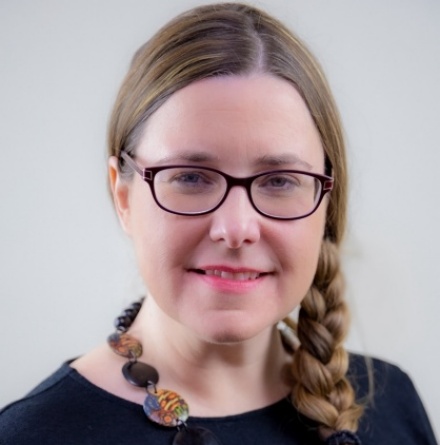
Heather Killen, PhD

What project, question or area of research best represents your time with the Institute for Learning Sciences?
I’m grateful for the opportunity to grow my community-based scholarship through our work developing a learning agenda with two Buffalo neighborhoods facing transportation infrastructure challenges. Exploring how a community identifies who needs to learn what deepened my understanding of how knowledge building can lead to action. Sharing our insights both through a public showcase and academic conferences within planning and the learning sciences powerfully demonstrated what generative transdisciplinary research partnerships can be.
How did joining the institute as part of a three-person postdoctoral cohort shape your experience?
One of the strongest motivations for applying to this position was the opportunity to work as part of a cohort. My dissertation research was an independent project that I designed and conducted myself. It was incredibly rewarding but ultimately a bit lonely. I was thrilled to join Xintian and Ari and to be able to learn alongside amazing peers as we explored the work of the institute together.
What are you most proud of from your time at UB?
I am especially proud of helping to bring the Learning Sciences Graduate Student Conference (LSGSC) back after a four-year hiatus. The free, student-organized conference will be held at Foster Hall this fall. LSGSC was a formative experience for me and so many others, including many current GSE faculty members. I first met both Xintian and Ari at LSGSC conferences years before we were hired together at the institute. I am thrilled to help create an opportunity for the newest group of learning sciences students to connect, share their early work and build their professional community.
What idea, lesson or collaboration from your time at UB will you carry into your next chapter?
I will carry forward the power of developing theoretically grounded research in local systems and communities. During my time at UB, I’ve had the opportunity to contribute to several GSE research proposals and I am looking forward to continuing an association with UB in two research roles: with work led by Dr. Christine Wang and Dr. Chris Proctor to better understand how to build equitable AI literacy in early childhood; and work led by Dr. Alexandra Schindel to use New York State’s newly approved climate change education graduation requirement to examine how education systems enact statewide instructional and infrastructural reforms. Across the work I’ve been a part of, I’ve been impressed with how the strengths of Western New York, and the deep relationships faculty have built within those systems and communities, are being used to generate insights relevant to people both locally and across the world.
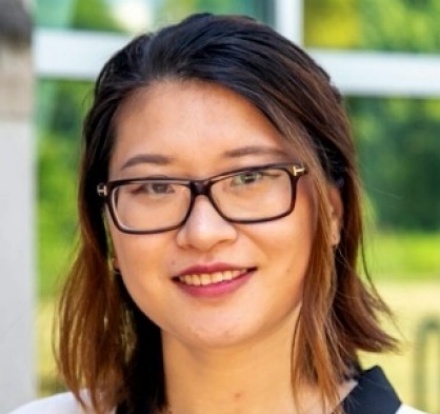
Xintian Tu-Shea, PhD

What project, question or area of research best represents your time with the Institute for Learning Sciences?
In my time with the institute, I have explored how emerging technologies, particularly artificial intelligence, can be meaningfully integrated into learning environments while remaining responsive to the needs of learners, educators, families and communities. Through work, including with the Center for Early Literacy and Responsible AI (CELaRAI), I have been able to explore AI-supported literacy learning for children, investigate how young learners perceive and interact with AI tools, and develop educational workshops that introduce AI concepts to broader audiences.
How did joining the institute as part of a three-person postdoctoral cohort shape your experience?
Rather than working in isolation, by joining the institute with Heather and Ari, I had the opportunity to learn from peers with complementary research interests and perspectives. By engaging in regular conversations and informal problem-solving sessions, and by sharing experiences as we navigated institute goals, we were able to create an environment that was intellectually stimulating and personally supportive.
What are you most proud of from your time at UB?
A particularly meaningful aspect of my experience was mentoring graduate students and helping to support their professional development. I provided structured mentorship to UB students in research design, data collection, qualitative analysis and academic scholarship. I had the opportunity to extend this mentorship through leadership roles as secretary and treasurer of the AERA SIG Learning Sciences and as a member of the International Society of the Learning Sciences Membership Committee. Supporting students and early-career scholars to grow in confidence as researchers and contributors to the field has been very rewarding.
What idea, lesson or collaboration from your time at UB will you carry into your next chapter?
One lesson I will carry forward from my time at UB is the importance of collaboration. Through my experiences organizing community workshops, building partnerships with Buffalo organizations, collaborating with fellow postdoctoral scholars and mentoring graduate students, I saw that the most meaningful research and educational innovation rarely happen in isolation. The strongest projects emerged through partnerships among researchers, graduate students, educators, community organizations and families—each bringing unique expertise and perspectives to the work.
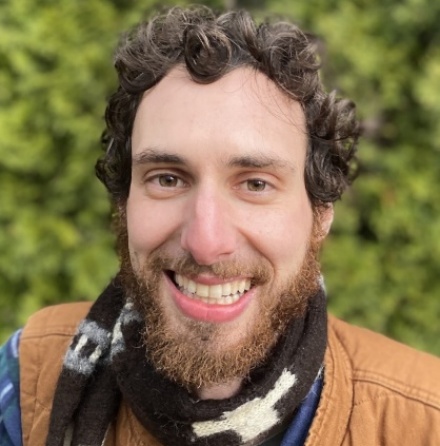
Ari Hock, PhD

What project, question or area of research best represents your time with the Institute for Learning Sciences?
Street Smarts! Chris Hoadley and I are working on a video series where we film learning scientists chatting about their research with people on the street (or on the sidewalk, in the park, etc.). This dialogue shows how much academics and the general public can learn from each other.
How did joining the institute as part of a three-person postdoctoral cohort shape your experience?
This cohort demonstrates a different model of what a postdoc could be. Instead of working in silos on our individual research, we’ve formed a community of practice, generating new ideas and supporting each other.
What are you most proud of from your time at UB?
Heather, Chris and I attended the main urban planning conference this year and led a workshop on conjecture mapping. The planners were not familiar with this tool, which learning scientists use to articulate a theory of change. But they took to it right away and began thinking about the learning processes and outcomes associated with their work.
What idea, lesson or collaboration from your time at UB will you carry into your next chapter?
We’ve just submitted a grant to expand the work we’ve been doing around neighborhood visioning and highway reform in Buffalo. These are issues that affect all of us but can be quite contentious. I’ve learned that we get a lot further when we find ways to intentionally collaborate across disciplines, sectors and neighborhoods.
Tuesday News Briefs feature the stories of the Graduate School of Education faculty, students and alumni who are engaged in their communities and making an impact through their hard work, dedication and research initiatives. If you have a story to share, please email us with the details for consideration as a future news feature. | Email Us Your Story