

Published April 16, 2026
BY DANIELLE LEGARE
GSE faculty member explores digital video as a tool for multimodal teaching
As digital video has become a constant presence in students’ lives, its role in classrooms has often lagged behind and been treated as an add-on rather than a core mode of learning, expression and assessment.

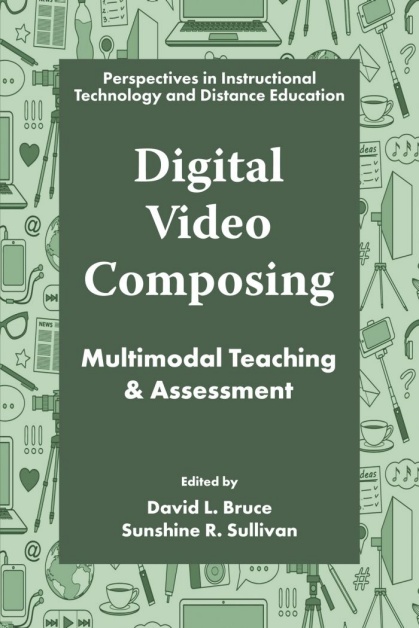
In a new book, “Digital Video Composing: Multimodal Teaching & Assessment,” University at Buffalo Graduate School of Education faculty member David L. Bruce brings together scholars and practitioners to examine how digital video is used intentionally across a range of educational contexts.
Published in December 2025 by Emerald Publishing, the book—coedited by Bruce and Sunshine R. Sullivan, a special education teacher and former Houghton University professor—explores how teachers and learners use digital video to support critical thinking, creativity and equitable access to learning across urban and rural classrooms, as well as online and out-of-school spaces.
Bruce, associate professor of learning and instruction, traces his interest in digital video composition to his early teaching career, when he taught both English and media studies, often to the same students.
“I was originally an English literature major, with a speech communication minor,” Bruce said. “My first teaching job was teaching English, but the school also had a TV studio funded through public access... I had no production or film experience, so I had to use what I knew from literature and composition and apply it to how you read media and how you compose media.”
As he entered doctoral studies while continuing to teach high school, Bruce observed striking parallels between print-based composition and media production.
“For me, digital video became a huge entry point for students to find expression and find their voice in ways they couldn’t otherwise,” he said. “I had a student in my media studies class who was failing his English class but was one of the most talented videographers and editors I’d ever worked with. I realized he was doing the same kinds of thinking, just in a different medium.”
That realization led Bruce to focus on “transmediation”: the use of one mode of expression to support understanding in another. Over the course of his career, he has researched and taught digital video as a compositional practice, often exploring how the modes of writing and video intersect and complement one another.
While research on digital video in classrooms has grown over the past decade, Bruce said that many educators still approach it cautiously, often because they have not had opportunities to work with media themselves.
The book responds to that gap by pairing theory with grounded examples of practice. Divided into three sections—foundational aspects of digital video, portraits of educational practice and applications in teacher preparation and professional development—the chapters draw on frameworks such as multimodality, critical literacies, anti-racism, trauma-informed care and semiotics.
“One chapter looks at students using TikTok-style makeup tutorials as a way to engage in anti-racist critique and share cultural counter-stories,” he said. “Another chapter looks at how students in a rural outreach center used video composing as part of trauma-informed care. It shows how the same tool can be used in vastly different contexts but always centered on learners.”
Bruce also emphasizes that access and equity are central themes throughout the book.
“What I’ve found is that there’s an equity issue we don’t talk about much, and that’s access to other ways of learning. We tend to think about equity mainly in economic terms, but students in Western New York—and really across the country—are getting a heavy diet of print in a world that has vastly outpaced the compositional blue book essay. Read this print text, write this print response. We don’t live in a world like that anymore,” Bruce said.
“Students are learning media practices mostly in non-school-sanctioned spaces, with very little adult mediation. That’s a huge equity issue, because when teachers are versed in this work, they can help students apply the same analysis, critique and compositional tools we value in traditional writing, but students rarely get the chance to express themselves that way,” Bruce added.

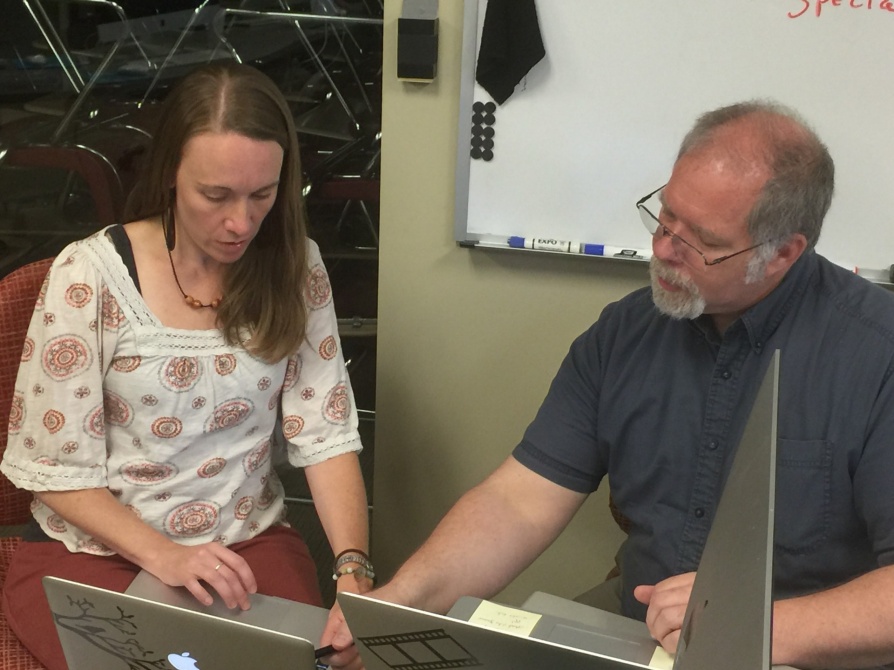
Sunshine R. Sullivan (left) and David L. Bruce (right), conducting a digital video workshop.
The volume is coedited by Sunshine R. Sullivan, a GSE alumna who completed her doctoral work in curriculum and instruction with a focus on literacy.
“Throughout my time at GSE, I had a core group of peers who worked together on various projects,” she said. “We developed our abilities to work with others who had different strengths and experiences. Our projects were better because we built on one another and energized each other. Our professors encouraged this kind of collaboration. David was one of those professors. He organized his class in a way that positioned us as experts and encouraged us in our inquiries.”
Bruce and Sullivan first collaborated through professional development initiatives with Western New York educators before bringing this larger project to fruition.
Bruce and Sullivan hope the book reaches teacher educators, classroom teachers and scholars alike. “We intentionally connect our experiences as public educators and higher education educators together with our research,” Sullivan said.
Above all, Bruce hopes that readers come away with a reframed understanding of technology’s role in learning.
“It’s a powerful tool, but it’s still a tool,” he said. “The focus shouldn’t be on the technology itself, but on how learners and teachers use it. That’s where the creativity and innovation really happen.”