
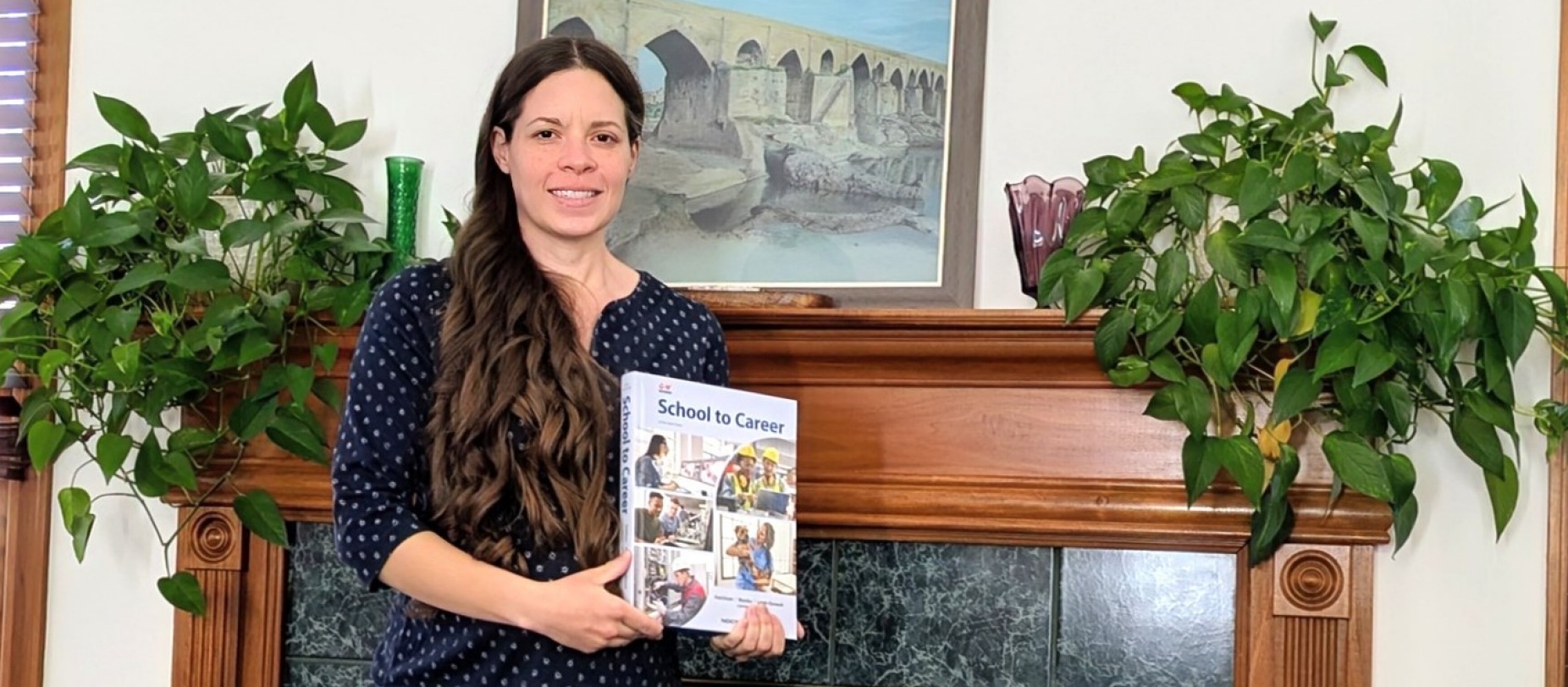
Katheryne T. Leigh-Osroosh holds the latest edition of “School to Career,” a career and technical education textbook.
Published March 19, 2026
BY DANIELLE LEGARE
Reshaping career readiness: GSE faculty coauthors updated textbook
When the world of work changes, career preparation has to change with it. From artificial intelligence reviewing résumés to employers screening candidates on social media, today’s students are entering a job market that looks nothing like the one their parents experienced.

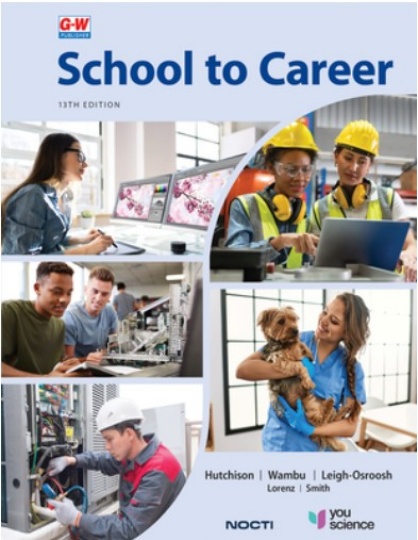
That reality helped shape the newly released 13th edition of “School to Career,” a career and technical education textbook coauthored by Katheryne T. Leigh-Osroosh, assistant professor of school counseling at the University at Buffalo Graduate School of Education.
“It’s the 13th edition of a career and technical education textbook, and this is the second edition that my coauthors and I have written,” Leigh-Osroosh said. “What made this different than the previous authors and previous editions was the inclusion of updated career clusters. The National Career Association and folks who do postsecondary transition updated the career clusters, and that plays a significant role in how school counselors and high schools prepare students for postsecondary success.”
The updated career cluster framework reflects a shift away from rigid occupational “domains” toward a more interdisciplinary model that emphasizes the transferability of skills, in response to a workforce increasingly defined by layoffs, retraining and career pivots.
Preparing students for an AI-driven job market
Leigh-Osroosh led major revisions to Chapters 8–13, including the technology chapter, where the team introduced foundational instruction on artificial intelligence and responsible technology use.
“We updated that to include some foundational understanding of AI—mostly definitions—and a prelude into how AI may play a role in the workplace without trying to foretell too much,” she said. “But being honest about how that’s going to shift the ways we think about work and the ways employers think about hiring.”
“How many job postings are being reviewed by AI bots and not a human is significant now,” she added. “It’s not like it was in the past, where you could just walk in and hand them a résumé.”
Beyond college or trades
While career education often becomes framed as “college versus the trades,” Leigh-Osroosh explains that the book intentionally presents a broader view.
“We really try to offer schools and students exposure to multiple career paths that don’t just focus on postsecondary and don’t just focus on the trades,” she said. “We look at careers that have expected growth within the next 10 years—ones that may require a degree, but also ones that may just require a high school diploma or technical training.”
That perspective makes the text useful not only for students, but also for classroom teachers, out-of-school programs and community organizations working with youth.
“There are life skills in it: how to balance a checkbook, how to write an email,” she said. “Even folks who are outside of K-12 but work with youth or young adults could benefit from using this as a reference or guide.”
Problem-based learning with a portfolio
Leigh-Osroosh and her coauthors—Brian Hutchison, PhD, LPC; Grace Wambu, EdD, LAC, NCC; James H. Lorenz, EdD; and Harry T. Smith, EdD—updated the book’s emphasis on problem-based learning by replacing traditional multiple-choice assessments with applied tasks aligned to current state standards.
“I really enjoyed the challenge of finding ways to still get the necessary information out there while making it accessible to schools and students across the nation,” Leigh-Osroosh said. “There’s more of a focus on problem-based learning with the assessments of each chapter, which aligns with where K-12 education is going overall.”
The text also guides students through building a career portfolio across chapters.
“We purposefully did that so they’re actually building a portfolio as they go through the book,” she said. “At the end, students have exemplars of their résumé, their interests and things they can use when they’re applying for jobs.”
Designing a life, not just a career
At its core, Leigh-Osroosh hopes the book offers something students may not feel they have right now: perspective and hope.
“I hope high schoolers will know that while everything is changing rapidly, some of the basics still apply, like understanding your values and your interests and finding ways to balance work that addresses those needs,” she said. “Work doesn’t always mean you’re going to find one thing that fits all of your interests or passions. Sometimes it’s designing your life so that what brings in the money fuels the passion.”
“Hopefully, it adds some hope to the world of work we’re in right now, which is difficult,” she continued. “I want students to see that there are different pathways and opportunities, and they don’t have to abandon their interests to design a life that works for them.”