
Published February 19, 2026
BY DANIELLE LEGARE
GSE faculty edits new book on doctoral education
Long before “The Self-Determined Doctorate” was published, Africa S. Hands was already thinking about what helps—and hinders—doctoral students as they navigate one of the most demanding phases of their academic lives.
Hands, assistant professor of information science at the University at Buffalo Graduate School of Education, is the co-editor of “The Self-Determined Doctorate: Perspectives on Leading the Doctoral Journey.” The new book was published in October 2025 by De Gruyter Brill as part of its Doctoral Journey in Education series. The peer-reviewed volume brings together narratives from scholars who reflect on how autonomy, community and self-direction shaped their doctoral experiences.

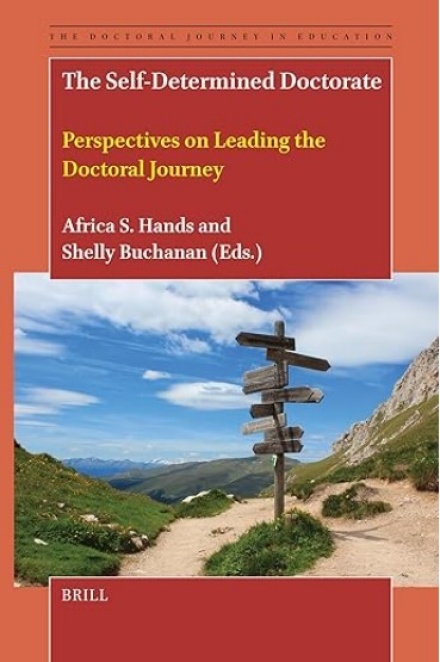
“The Self-Determined Doctorate,” co-edited by Africa Hands and published by De Gruyter Brill in 2025.
The book builds on Hands’ long-standing interest in doctoral student motivation, a research focus that dates back to her own graduate training.
She co-edited the volume with Shelly Buchanan, a longtime collaborator and fellow doctoral alum, after recognizing shared patterns in their own experiences and in the stories they continued to hear from others.
Both editors drew on self-determination theory, a motivational framework centered, in part, on three basic psychological needs: competence, relatedness and autonomy. While Hands and Buchanan felt those needs were met in their own programs, they came to realize that many doctoral students are not as fortunate.
“We felt like we had that in our doctoral programs,” Hands said. “And we know that others don’t always have those opportunities, especially around autonomy and relatedness.”
Rather than focusing on a single discipline, the book features contributors who studied in the United States, Sweden and Australia across fields such as education, history, and library and information science. Many of the contributors are now faculty members, academic librarians or higher education administrators.
Across the chapters, a common theme emerges: when institutional support falls short, doctoral students often find ways to create what they need themselves.
“If things weren’t happening in their programs, the authors took it upon themselves to make them happen instead of waiting on an administrator or faculty advisor,” said Hands.
Several chapters highlight the role of community—both formal and informal—in sustaining students through the doctoral process. One contributor describes building a support network during the isolation of the COVID-19 pandemic, while another chapter examines how two doctoral students navigated self-doubt by forming a critical friendship that helped them move between feeling like novices and emerging experts.
Hands describes the doctoral experience as “a very public, private event.”
“After your classes are done, it’s up to you to make this thing work,” she said. “You’re working privately, but a lot of people know you’re in a doctoral program. And no one wants to ask you, ‘Where are you in your studies?’ or ‘How’s your dissertation going? Are you almost done?’”
“It’s this weird space of doing something that’s so big and so personal but having other people know about it,” Hands added.
The book is intended for a broad audience, including current and prospective doctoral students, as well as faculty members and program administrators.
Now a doctoral advisor herself, Hands said editing the volume has influenced how she approaches mentoring.
“Ultimately, this is the student’s degree. This is their personal project and research that they’re working on,” she said. “My role is to support them, help them navigate the process and gently guide them, and correct course as needed.”
“A lot of times, we start with these big, grand ideas, but we really just need one dissertation and help narrowing it down into one complete, focused project,” she continued.
For Hands, a first-generation doctoral graduate, the project is part of a larger effort to make doctoral education more humane and accessible.
“We don’t want to be gatekeepers,” she said. “There’s enough of that already happening in higher ed… I try to extend opportunities to master’s and doctoral students as much as I can, letting them know about different opportunities to get their work out there.”