
Published February 24, 2026
BY DANIELLE LEGARE
GSE professor brings Black history education expertise to Education Week series
Each February, LaGarrett J. King, professor in the University at Buffalo Graduate School of Education, serves as a guest editor for Education Week’s Black History Month opinion project, helping bring research-informed Black history teaching into a national conversation accessible to educators across the country.

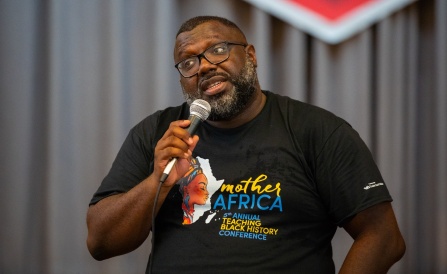
King, a leading expert in Black history education and the founding director of UB’s Center for K–12 Black History and Racial Literacy Education, has held this guest editor role for six years. His partnership with Education Week has expanded the reach of his scholarship and created opportunities for GSE students to publish alongside him.
“Education Week provides an important national platform to connect research on Black history education with the educators who are implementing it in real time,” said King. “Partnerships like this help move Black history beyond a once-a-year celebration and toward the kind of year-round integration into curriculum that Carter G. Woodson originally envisioned.”
This year’s Education Week series, “A Century of Celebrating Black History,” marks the 100-year anniversary of Negro History Week and the 50-year anniversary of Black History Month.
In a note introducing the collection, King reflects on Carter G. Woodson’s original goal of embedding Black history into everyday teaching and learning, while highlighting persistent gaps in curriculum and uneven institutional support.
“One hundred years of celebrating anything is quite an accomplishment. However, as I reflect on this year, I am left wondering: Are we where we need to be as a society with Black history?” King wrote.
He also contributed two essays to the series.
In “Why We Need to Study the Black Founders Who Shaped U.S. Democracy,” he argues the traditional framing of America’s “founding fathers” is too narrow. He offers a broader definition of “Black founders” that highlights African and African Americans who built institutions, advocated for emancipation and shaped dialogue around Black identity in the 18th and 19th centuries.
King also authored “The 100-Year History of Black History Month,” which examines common misconceptions about Black History Month and why the work of Black history education remains urgent.
In addition, this year’s collection features perspectives from two GSE doctoral students:
- Abigail Henry, a doctoral student and graduate fellow with UB’s Center for K–12 Black History and Racial Literacy Education, introduces her “jawn of engagement,” a discussion-first approach designed to support students in rigorous conversations about race before analyzing Black historical sources.
- Nick Kennedy, a high school English teacher and doctoral student at UB, shares the “Sankofa Framework,” a step-by-step classroom routine designed to help students excavate truths from primary sources in Black history through context, knowledge-building, omissions and emotional impact.
King’s commitment to elevating student voices in a national forum has been a hallmark of the February project.
In recent years, additional GSE students and center-affiliated graduate fellows—including Daphanie Bibbs, Dawnavyn M. James, De’Ana Forbes and Greg Simmons—have also contributed Education Week pieces and curated classroom resources.
“Inviting doctoral students to contribute to this series reflects the importance of ensuring that emerging scholars have opportunities to share their perspectives on Black history education with a national audience of practitioners,” King said.
Tuesday News Briefs feature the stories of the Graduate School of Education faculty, students and alumni who are engaged in their communities and making an impact through their hard work, dedication and research initiatives. If you have a story to share, please email us with the details for consideration as a future news feature.