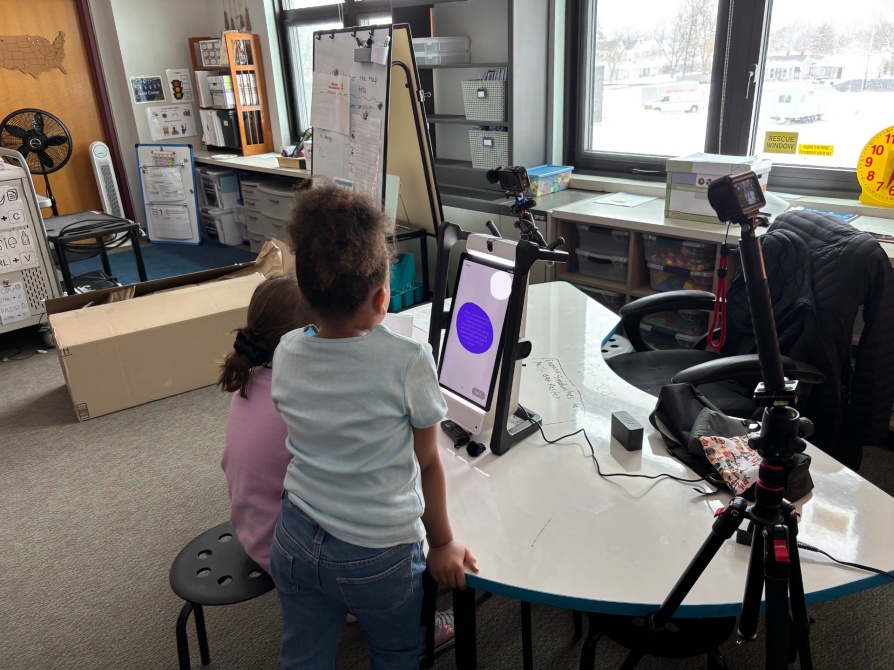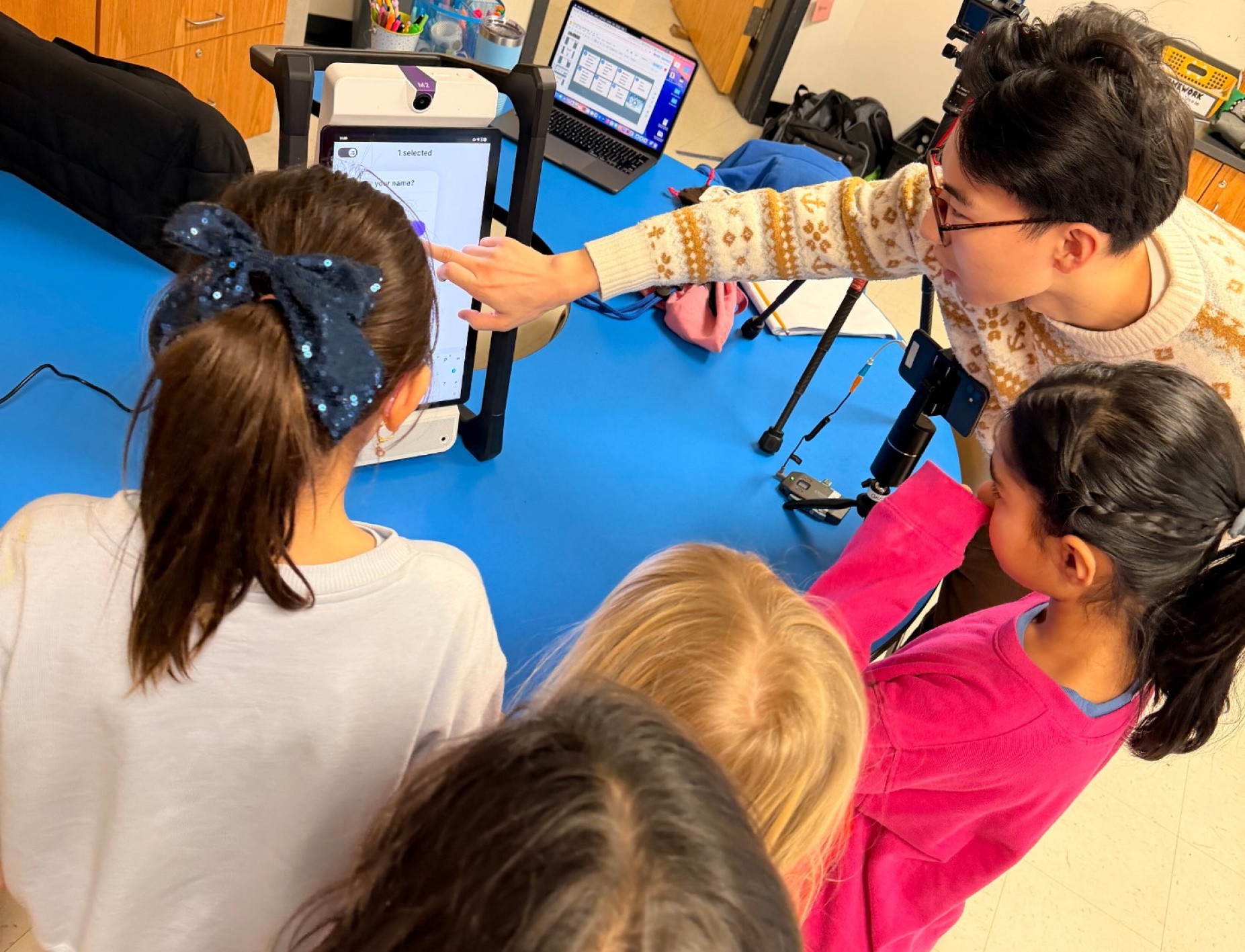
A UB doctoral student assists four elementary students as they prepare to use the M2 device during an engineering design activity.
Published September 17, 2026
BY DANIELLE LEGARE
Building better reflection: UB researchers explore integration of AI in elementary engineering education

After elementary students build and test an engineering prototype, an important part of the learning process begins: reflecting on what worked, what did not and what students might change.
Giving every student enough time and support for that reflection can be difficult in a busy classroom. Mary McVee, professor of literacy education at the University at Buffalo Graduate School of Education and director of the UB Center for Literacy and Reading Instruction, is leading a pilot study exploring whether an AI-assisted conversational tool can help.
“What happens if we introduce this AI conversational partner at that point to help children reflect on the process of engineering design?” McVee said. “That’s really what this project is attempting to do.”
The study builds on McVee’s National Science Foundation-funded project, “Elementary Teacher Professional Learning in Equitable Engineering Pedagogies for Multilingual Students.” The broader project brings together literacy, language and engineering education to help elementary teachers develop more inclusive approaches to teaching engineering, particularly in classrooms serving multilingual students.
Connecting engineering, literacy and reflection
Engineering has become a more prominent part of elementary STEM instruction through changes in state and national standards, but many elementary teachers have had little preparation in teaching the subject. McVee and her collaborators have been exploring how teachers can connect engineering design challenges with children’s literature.
Students might read a book that presents a problem, then design and test a prototype in response. The approach gives them opportunities to develop engineering knowledge while drawing on their language, literacy and cultural resources.
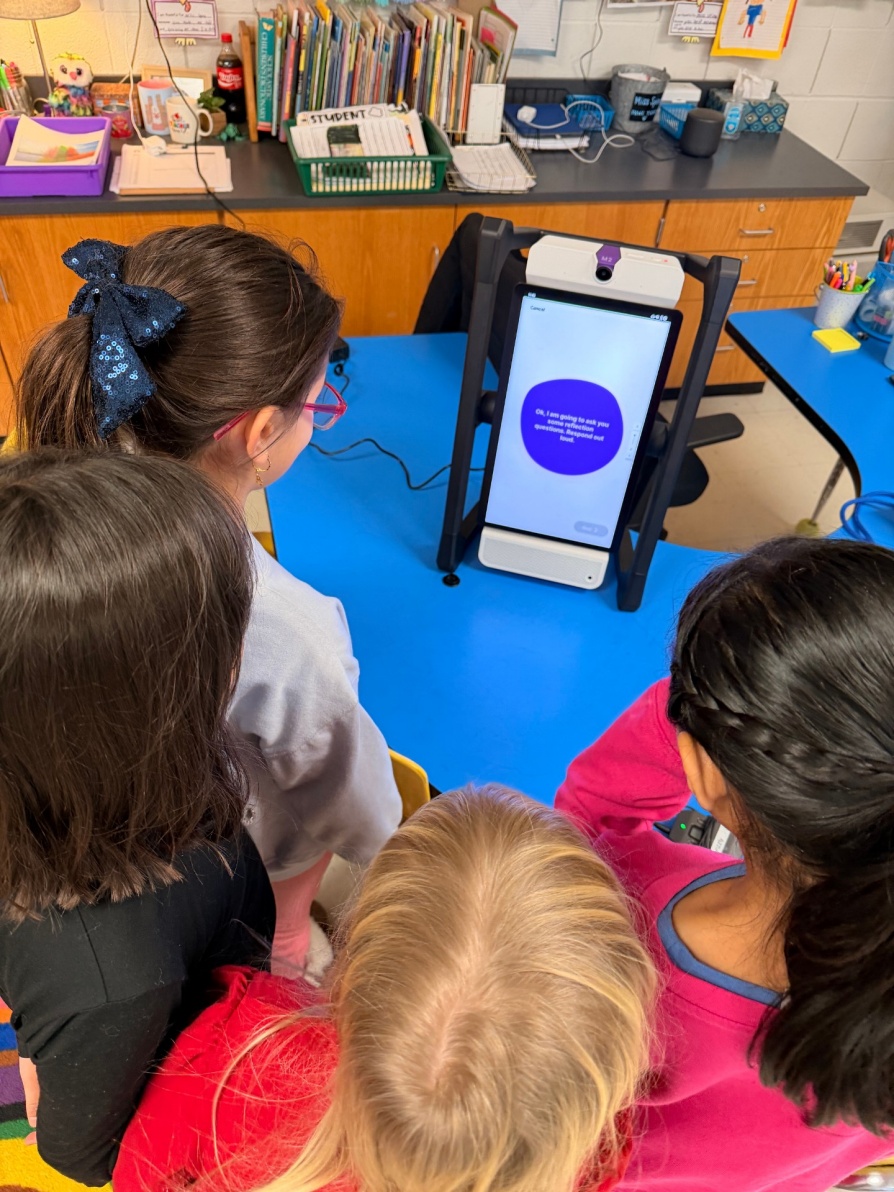
The new pilot introduces the M2 device and its MirrorTalk software, developed by Swivl, during the reflection stage of that process. Students visit the device in small groups after testing their prototypes. M2 asks them to identify the most successful part of their design, explain why it worked, discuss a challenge and consider how they would redesign the prototype.
The prompts are designed to ask one question at a time, use students’ own words in follow-up questions and invite additional group members to participate when one student is doing most of the talking. When students have difficulty responding, the tool is instructed to simplify the question or provide a hint rather than leaving them stuck.
McVee said the technology could help address a practical challenge teachers repeatedly raised during the NSF project. “Oftentimes, there’s only one teacher, and the teacher doesn’t have the bandwidth because they can’t reflect with every child at the same time,” she said.
The technology also has multilingual capabilities. A student who does not understand a question in English may ask for clarification in another language and receive a translated response.
At the same time, the pilot is not based on the assumption that technology can replace a teacher’s judgment or support. “I don’t think this is going to replace teachers anytime soon,” McVee said.
Early classroom experiences have already shown why.
Students sometimes need help understanding whether they should speak to the device, their teacher or their classmates. The technology also relies on spoken language. If a student points to a prototype and refers only to “this part,” M2 cannot see what the student means.
Testing the technology
McVee is leading the pilot with co-principal investigator Jess Swenson of UB’s Department of Engineering Education. Doctoral students Zhehan Zheng, Jingning He and Abdelhamid Touti have played an important role in developing, testing and revising the prompts used with M2.
The team is working with teachers and students in two local school districts that also participated in the NSF-funded project.
“I thought there might be pushback from the teachers, or at least resistance,” McVee said. “They were so interested in this. They were like, ‘Yeah, let’s just see what happens.’”
Support for classroom-based AI research
The study is supported by $30,730 through UB LAUNCH, including $15,365 from the university and matching support from GSE and CLaRI. UB created LAUNCH to help researchers adapt their work amid changing federal priorities, including a growing emphasis on artificial intelligence.
The LAUNCH funding allowed the team to explore an AI-related extension of research McVee had already been considering while building on the school partnerships and engineering work established through the NSF project. It also provided paid research opportunities for doctoral students and enabled the team to study the technology in real classrooms rather than relying solely on surveys of educators’ attitudes toward AI.
“You hear a lot about, ‘Is AI good or is AI bad? Should we use AI or should we not use AI?’” she said. “In this case, we have a space where we can play around, and it’s not either-or. It’s: What does this afford? What are the limitations? What could be made better? What doesn’t work so well?”