
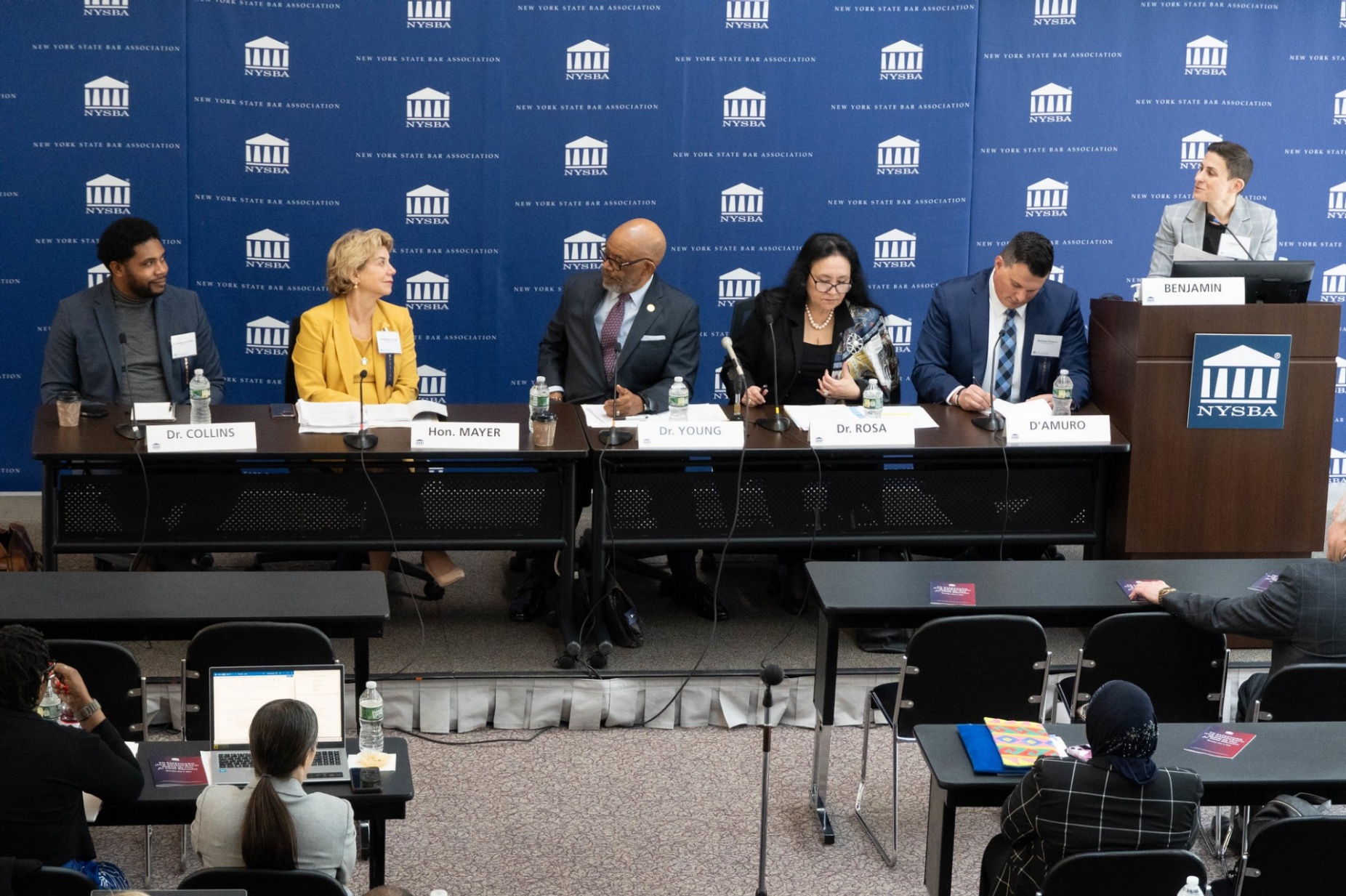
Nicholas D’Amuro participated in a panel discussion at a New York State Bar Association event.
Published June 11, 2026
BY DANIELLE LEGARE
Published with purpose: GSE student turns civic education research into a call for change
When Nicholas D’Amuro looks at the state of civic education, he sees a problem that begins long before students reach high school.

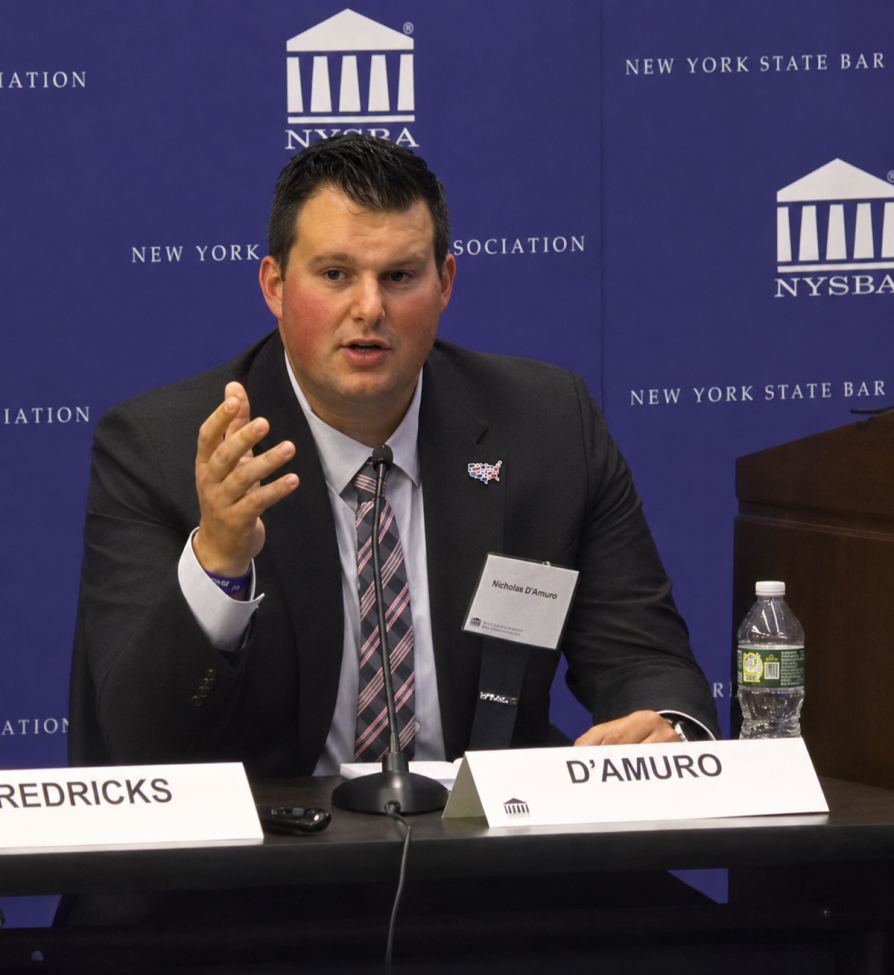
In his recent opinion piece for The Fulcrum, “We’re Starting Civic Education Way Too Late—and Paying the Price,” D’Amuro argues that schools are asking students to understand democratic institutions, civic responsibility and political participation without giving them enough time to build that knowledge in the first place.
For D’Amuro, an EdD student in the University at Buffalo Graduate School of Education’s learning and teaching in social contexts program, the article is an extension of the work he is pursuing through his doctoral research: examining the marginalization of elementary social studies instruction—particularly in rural school contexts—and exploring how teachers can be better supported in bringing social studies and civic learning into their classrooms.
“We get really upset with students who don’t care,” D’Amuro said. “But we haven’t really given them a robust view of their world until seventh grade.”
D’Amuro serves as coordinator of school improvement at Genesee Valley BOCES and interim executive director of the Wyoming County Business Education Council. Before joining BOCES, he spent 10 years teaching social studies at the Holley Central School District.
Today, his work centers on helping schools strengthen social studies instruction, build students’ background knowledge and create opportunities for civic dialogue.
“Social studies and bridging political divides—it’s personal, because I have two children,” D’Amuro said. “Civics and politics are a big part of my household. We talk about religion and politics respectfully. You can have strong opinions, but there’s a way you treat people. I want that for my kids.”
Studying a gap in civic learning
Through his dissertation in practice, D’Amuro is studying how elementary teachers describe their experiences with a five-part professional development series focused on the inquiry design model. This approach begins with compelling questions and guides students through investigation, evidence and argument.
Rather than solely identifying barriers to elementary social studies instruction, D’Amuro wants his research to help address them.
Those barriers often include limited instructional time, testing pressures and the perception that social studies is less essential than subjects assessed annually, such as math and English language arts. In New York State, social studies is not assessed in the elementary grades, and D’Amuro said that absence sends an unintended message.
Published in February 2026, his article in The Fulcrum takes that concern to a wider audience. In the piece, he calls for earlier and more sustained civic learning in elementary schools, including consideration of ways New York State could expand civic readiness opportunities before seventh grade.
D’Amuro believes students need opportunities to study history, understand community responsibilities, discuss fairness and explore how people shape public life. Those early experiences can help students see themselves as part of a larger civic story.
"Trust in democratic institutions is at a generational low, and the loudest explanations tend to focus on social media, polarization and partisanship,” said D’Amuro’s advisor, Tiffany Karalis Noel, clinical associate professor in the Department of Learning and Instruction and GSE’s director of doctoral programs. “Nick's research points somewhere earlier and less examined: the elementary classroom where social studies was systematically displaced by testing pressure and never fully recovered. He is working with rural teachers who want to change that, and asking what they actually need to make it possible.”
A wider commitment to civic learning
According to D’Amuro, the structure of his EdD program has enabled him to pursue doctoral study while continuing his work across school districts, supporting civic education initiatives and balancing family life.
“The program has been a joy,” he said. “The freedom to study what you’re interested in—and the remote learning aspect, with a great advisor and director—has been absolutely everything I wanted and more.”
His commitment to civic learning reaches beyond doctoral research. In 2024, he co-founded the Civi Coalition, a professional learning community that has grown from 10 teachers to more than 120 educators across New York State. The coalition focuses on civic education and bridging divides in the classroom.
Through his research, writing and work with educators, D’Amuro is pushing for a broader shift in how schools think about civic education—not as something to save for adolescence, but as a foundation students begin building early.
He wants his children and students to see that working to improve civic life is worth the effort: “When you see an ill in the world, you can still do something to make a change.”