University at Buffalo (UB)
University at Buffalo excavations in ancient Italy reveal economic and medieval history

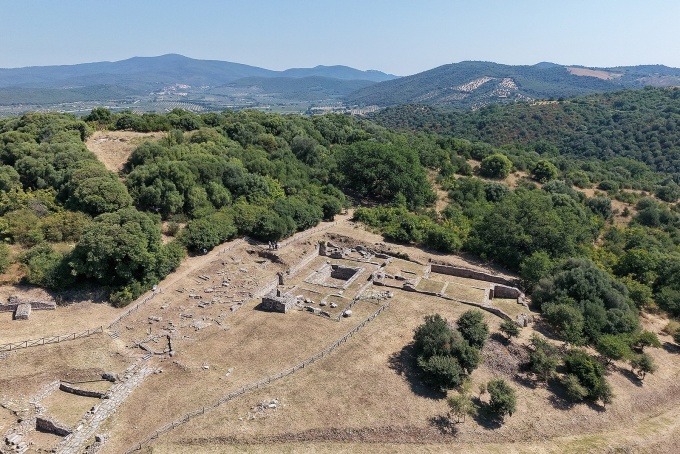
An aerial view of the area of the medieval cathedral with the cemetery under investigation in Rusellae. Photo courtesy of Alessandro Sebastiani
Release Date: August 13, 2026


BUFFALO, N.Y. – Two recent archeological excavations led by a University at Buffalo researcher are offering new insights into the workings of ancient civilizations.
Alessandro Sebastiani, PhD, and associate professor and chair in the Department of Classics, is the director and lead researcher for both excavations, which are part of the IMPERO project, an archaeological program based in the department.
Alessandro says a team of specialists, faculty and students from UB and partner institutions working at a Hellenistic settlement of Podere Cannicci in southern Tuscany in Italy uncovered an agricultural warehouse, containing 24 large ceramic vessels, known as “dolia,” used for storing grain, wine or olive oil, that were remarkably preserved in their original location.
“This is the first large-scale facility of this kind identified at the settlement and provides important new evidence for understanding the collection, storage and redistribution of agricultural products, particularly grain,” says Alessandro, who has directed work at Podere Cannicci since the project began in 2017.
The existence of the warehouse provides physical evidence that agricultural products were being collected and stored on a scale exceeding the immediate needs of a single household.
“This suggests that Podere Cannicci functioned not merely as a rural village, but as an organized economic center serving the surrounding territory,” says Alessandro. “This discovery will allow us to reconstruct previously unknown aspects of the administrative and economic organization of this part of Etruria during the Hellenistic and Roman Republican (323 BCE to 30 BCE) periods.
Finding “dolia” in and of themselves is not remarkable. Individual pieces are relatively common at Roman-period sites. But it’s rare to find so many of them together, still preserved in their original positions, inside a purpose-built storage facility.
It’s a discovery that also carries a touch of irony, according to Alessandro.
“Their remarkable state of preservation is directly connected to the violent destruction of the settlement in the early first century BCE, most likely during the reprisals carried out by the forces of the Roman general Sulla,” he says. “The warehouse was destroyed by fire, and the intense heat caused its clay walls to collapse over the dolia, sealing and protecting them beneath the debris.
“It’s the destruction of the building that created the conditions that allowed the storage vessels and original arrangement to survive.”
A second project in Rusellae, an ancient town of Etruria, Italy, near Grosseto, Tuscany, began earlier this summer. Alessandro’s team in collaboration with Michigan State University, Texas Tech, and The College of New Jersey uncovered 10 burials with well-preserved skeletal remains dating to the Lombard and early medieval periods (568 CE to 774 CE).
A second phase of that project expanding the investigation area will continue in September. One of the goals is to determine the extent, chronology and spatial organization of that medieval cemetery.
“We also hope to understand how the burials relate to the medieval cathedral, the earlier Roman buildings and the changing urban landscape of Rusellae,” says Alessandro. “The site offers an exceptional opportunity to investigate how an important Etruscan and Roman city was transformed during the Lombard and early medieval periods.”
Radiocarbon dating, ancient DNA analysis and isotopic analysis of the remains can provide the researchers with valuable new information.
“These analyses well help us establish a more precise chronology and explore questions concerning ancestry, biological relationships, chronology, population mobility, diet, and the demographic history of the region,” says Alessandro.
He adds both discoveries are being prepared for scholarly publications and will also be presented to a broader public audience as part of an exhibition celebrating the 10th anniversary of the IMPERO project next year at the Archaeological Museum of Grosseto.
“These new findings demonstrate the international reach and scholarly impact of research conducted by the Department of Classics and the College of Arts and Sciences,” says Alessandro.
Media Contact Information
Bert Gambini
News Content Manager
Humanities, Economics, Social Sciences, Social Work, Libraries
Tel: 716-645-5334
gambini@buffalo.edu