Explore Our Program
At the ECRC, learning is joyful, purposeful and rooted in the power of play.

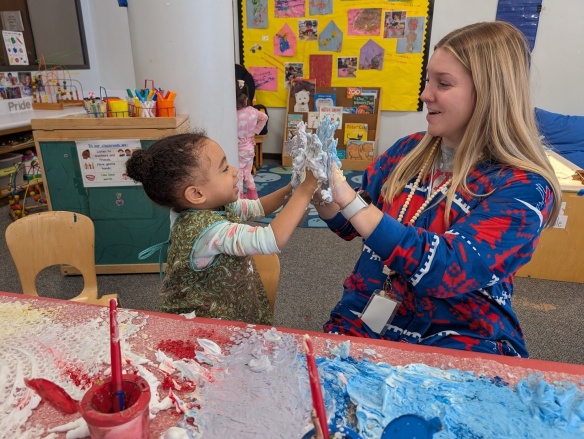
Dynamic Learning
Our curriculum blends child-led exploration with intentional guidance, nurturing curiosity, creativity and confidence. Through dynamic learning centers, engaging themes and enriching specials—from music and art to storytelling, yoga and mindfulness—children develop the social, emotional and cognitive skills that form a strong foundation for lifelong learning.
Play-Based Curriculum
Our play-based curriculum harnesses the power of play as a primary driver of learning and development. Through both structured and unstructured play experiences, children explore their surroundings, develop social and emotional skills, and lay a strong foundation for academic success.
Our approach centers on guided play strategies, where skilled educators intentionally design and scaffold activities that align with developmental milestones while allowing children to make choices and follow their interests. This balance between child-led exploration and teacher direction ensures that every play experience is both meaningful and purposeful.
Learning centers are integral to our program, offering thoughtfully arranged spaces—such as blocks, dramatic play, literacy and sensory areas—that encourage hands-on engagement, creativity and inquiry. In these centers, children are empowered to make decisions, fostering autonomy, confidence and a sense of ownership in their learning journey.
As children navigate these rich environments, they gain independence, strengthen collaboration skills and develop problem-solving abilities. Our curriculum supports holistic child development by honoring natural curiosity and intrinsic motivation, making learning joyful, engaging and impactful.
The ECRC is committed to ongoing research and innovation, ensuring our curriculum evolves to meet the needs of today’s young learners. By integrating best practices in early childhood education, current child development theory and advanced guided play strategies, we create dynamic learning environments that promote autonomy, independence and meaningful growth. Through regular reflection and assessment, we adapt activities and learning centers to support each child’s development while preserving the joy and power of play at the heart of our mission.
Typical Curriculum Themes
September | Getting to Know Myself and My Classroom |
|---|---|
September | Getting to Know My Family and Friends |
October | Farm |
October | Leaves, Apples and Pumpkins |
October – November | Community Helpers |
November | Gratitude & Family Togetherness |
November – December | Holiday Celebration! |
January | Winter & Hibernation |
|---|---|
January – February | Lunar New Year |
February | Love and Kindness |
February | Dental Health |
March | Author Studies |
April | Birds, Worms and Rabbits |
April | Celebrate our Earth |
May | Celebrate Good Times! |
Specials
An early education curriculum “special” is an enrichment activity such as music, art, storytelling or yoga that supplements the core curriculum. Specials provide unique hands-on experiences that foster creativity, self-expression and social-emotional growth while supporting overall child development.
Music Play
The MusicPlay Program, led by Miss Rachel from Joyful Sounds, nurtures and develops children’s natural musical abilities during the most formative years of early childhood. While music is not a language, it is learned in a similar way—through repeated exposure and active engagement. Just as children need to hear and experiment with language before speaking, reading and writing, they must also experience a wide variety of music before they can sing accurately, chant rhythms with precision and eventually read and write music.
MusicPlay offers a rich, immersive early childhood music education environment. Classes expose children to a diverse repertoire of songs and chants, many performed without words to help focus attention on the musical content. Educators model simple, creative movements and encourage sustained, continuous and relaxed motion, fostering both rhythm and body awareness.
To enhance engagement, the program incorporates props such as scarves, balls, egg shakers and hoops, allowing children to connect physically and creatively with music and movement. This play-based, interactive approach strengthens listening skills, coordination and self-expression, laying a strong foundation for a lifelong appreciation of music.
Creative Expressions
Each afternoon, our preschool and pre-K students come together to express themselves in a variety of ways. Children engage in activities focused on social-emotional learning, visual arts, storytelling and yoga and mindfulness.
Social Emotional Learning
Our social-emotional curriculum combines explicit instruction with child-led, play-based activities. Children build their emotional vocabulary, deepen bonds with their friends and practice social-emotional skills through activities such as puppetry, role play, games, cooking and more.
Visual Arts
Our visual arts program, led by Miss Keely, invites and inspires children to look at the world around them through the eyes of an artist. The question “what do you see?” can last a lifetime. Children learn to use their senses and focus their perception to learn about and interpret all that is around them through the world of art. With practical application, children view and appreciate art, play with art and create art. Guiding steps help children build their own visual and verbal language.
Storytelling
The way children understand the world is through stories. As they develop their unique voices, our storytelling program offers each child an opportunity to share their point of view with others. Children collaborate to re-tell beloved stories as well as write and perform their own stories. Through play, children develop early literacy skills, explore different characters, practice problem-solving and enliven their imaginations.
Yoga and Mindfulness
Yoga is a child-centered class that incorporates the practice of mindfulness and utilizes the imagination through imagery. Children learn poses, stretches and sequences of movement while discovering their breath and how it connects with their body and mind. They develop an awareness of their inner selves (interoception) and outer selves (proprioception) by following and leading each other in a variety of postures. Students learn to self-regulate, collaborate and move confidently. Each yoga class integrates the curricular theme.